
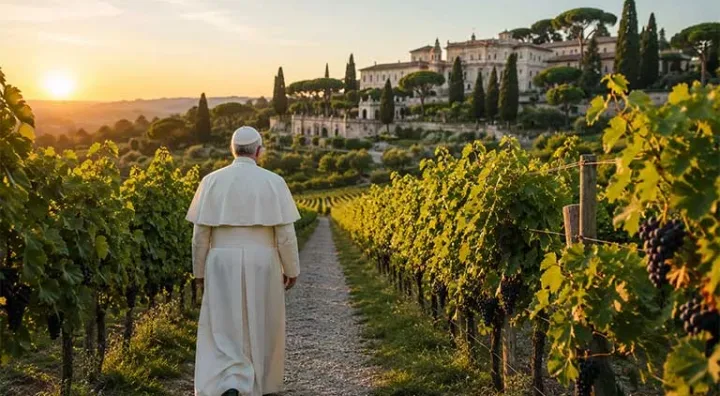
The Pope’s wine is now a reality: the first 5,000 bottles from the Castel Gandolfo vineyard reach the market
The sustainable agricultural project promoted by the Vatican at the papal residence of Castel Gandolfo has reached one of its most symbolic milestones. The first wine made from the vineyard planted within the Borgo Laudato Si complex, in collaboration with the Villa Russiz Foundation in the Friuli-Venezia Giulia region, has now been bottled, resulting in an initial production of 5,000 bottles of Cabernet Sauvignon grown according to organic and regenerative principles.
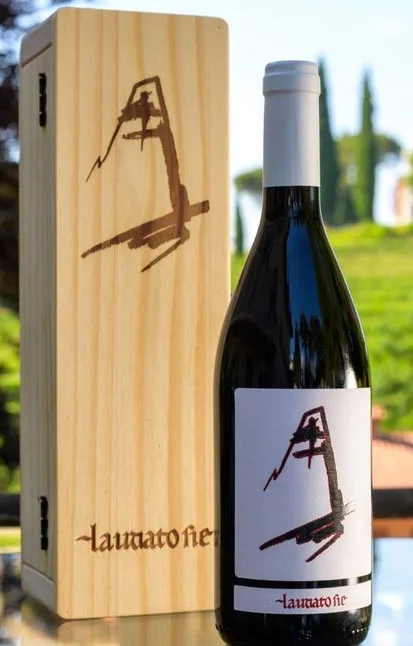
The initiative, promoted by Pope Leo XIV as part of a broad programme of environmental sustainability and social training, represents far more than a new wine label. It is a project that brings together agriculture, social inclusion, technological innovation and the principles set out in the encyclical Laudato Si', dedicated to the care of creation and the protection of the environment.
A vineyard within the Popes’ summer residence
The vineyard forms part of Borgo Laudato Si, an ambitious project developed on the grounds of the historic papal residence of Castel Gandolfo, located around 25 kilometres south of Rome, beside Lake Albano.
Although the pontifical estate has been known for centuries as the Popes’ summer retreat, in recent years it has undergone a profound transformation. Part of its gardens, agricultural areas and historic buildings have been integrated into a space dedicated to environmental education, sustainable agriculture and training for people in vulnerable situations.
Within this setting lies a plot of approximately two hectares planted exclusively with Cabernet Sauvignon, an international grape variety particularly well suited to the climatic conditions of Lazio.
From ecological vision to the first bottles
The recent harvest has made it possible to produce the first 5,000 bottles of wine from the pontifical vineyard. During a visit to the project, Pope Leo XIV blessed the facilities and took part in the celebrations that officially marked the birth of this new Vatican-linked wine.
According to those responsible for the project, once the vineyard reaches full productive maturity, annual output could be around 15,000 litres, equivalent to approximately 20,000 bottles of 75 centilitres.
Regenerative agriculture and technology serving the environment
One of the most innovative aspects of Borgo Laudato Si is its commitment to regenerative agriculture.
In addition to following organic production criteria, the estate incorporates smart irrigation systems designed to optimise water consumption using technologies based on artificial intelligence. These systems analyse the plants’ actual needs and supply only the necessary amount, significantly reducing resource waste.
Agricultural production at the complex is not limited to wine. Olive oil, artisan cheeses, herbal infusions and other products are also made on the estate itself, following a philosophy of local production and sustainability.
A project with a strong social dimension
The vineyard also plays an important social role. Around 8,000 vines are tended by refugees, migrants and unaccompanied minors taking part in training programmes focused on sustainable agriculture, livestock care and the management of hospitality activities.
The project also opens its doors to former prisoners and other people at risk of social exclusion, offering training and employment integration opportunities.
Those responsible for Borgo Laudato Si estimate that more than a thousand people each year could benefit from these educational and professional initiatives.
Riccardo Cotarella’s expertise leading the winemaking
Once the harvest is complete, the grapes pass into the hands of one of the most prestigious names in Italian wine: Riccardo Cotarella.
Regarded as one of Italy’s most influential consultant oenologists, Cotarella has taken part in numerous benchmark wine projects both within the country and abroad. His expertise has been fundamental in defining the style of this first Vatican wine.
Available information indicates that the Cabernet Sauvignon batches are aged in oak barrels before bottling, with the aim of bringing complexity and ageing potential to the wine.
Borgo Laudato Si: a legacy inspired by Pope Francis
The history of the project dates back to 2023, when the management of part of the pontifical estate was entrusted to the Laudato Si Centre for Higher Education.
Its aim was to turn the Castel Gandolfo grounds into a place where faith, sustainability and social action could coexist in practical terms. The official inauguration took place last year in a ceremony attended by representatives of the Church, local authorities, educators and project collaborators.
The name of the complex is a direct reference to the encyclical Laudato Si' published by Pope Francis in 2015, a document that has become one of the leading international references on integral ecology and environmental responsibility.
Where will the bottles be available to buy?
Although no international distribution plans have yet been announced, those responsible for the project have stated that part of the production will be sold within the Vatican itself and that some bottles will also be available to visitors to Borgo Laudato Si.
Sales within Vatican City also offer an interesting peculiarity for wine enthusiasts. Since the signing of the Lateran Pacts in 1929, the Vatican State has enjoyed a special tax regime that makes it a tax-free zone, a circumstance that has historically made it possible to buy wines and spirits at lower prices than in many parts of Italy.
With these first 5,000 bottles, the papal vineyard officially begins its commercial journey and becomes one of Europe’s most distinctive wine projects, combining agricultural tradition, sustainability, social inclusion and the backing of the world’s most influential religious institution.