
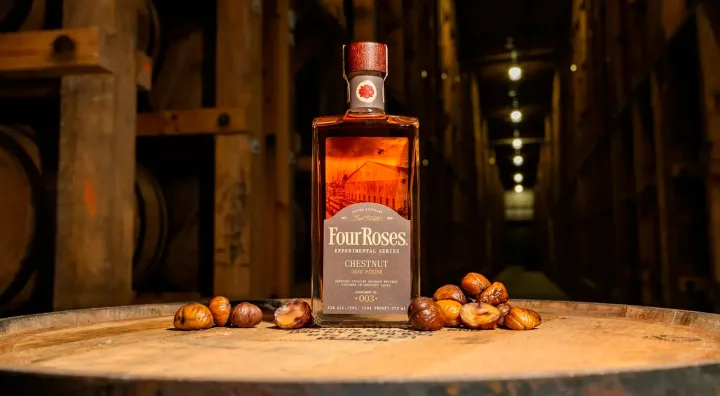
Wood does more than hold bourbon: it can also shape its aroma, texture and balance of sweetness and spice. Four Roses revisits this idea with Experimental Series No. 003: Chestnut, a release that examines the effect of chestnut wood on one of the distillery’s house profiles. It starts with a six-year-old bourbon, then adds a finishing period in Japanese chestnut casks.
The release continues a series in which the Kentucky distillery investigates how different materials and recipes interact (see our articles on honey and Mizunara).
Rather than moving away from its recognisable style, the aim is to see what an unusual wood can bring to a base already shaped by Four Roses’ blend of recipes.
A bourbon recipe as the starting point
Four Roses makes its bourbons using two mash bills and five yeast strains. Combining these variables creates ten recipes, each with its own profile. This gives the distillery room to explore differences in aroma and flavour without relying on a single base. For this release, it selected the OBSK recipe, described by the brand as spicy and complex.
The choice matters because wood finishing does not happen in isolation. The character of the spirit, its age and the time it spends in the cask all shape the result. Here, the intention is for the fruit and sweet notes associated with chestnut to complement the bourbon’s spicy profile rather than conceal it.
A cask-by-cask chestnut finish
The bourbon was transferred into 250-litre casks made from chestnut grown in Japan. The distillery used different levels of toasting and charring, two treatments that affect how the wood interacts with the liquid. Toasting can encourage sweet and spicy aromas, while the charred layer changes the spirit’s contact with the wood and contributes to its development.
The finishing period was not the same for every cask: each was sampled frequently and emptied once it reached the desired profile, after between five and eleven weeks. Monitoring each cask individually makes it easier to control the intensity of the wood. It also reflects an important principle in bourbon-making: cask time is not an automatic formula, since every vessel can develop differently.
Ripe fruit, vanilla and toasted wood
Four Roses’ published tasting notes describe aromas of apricot and soft vanilla. On the palate, the texture is rounded and creamy, with vanilla, pear and ripe cherry alongside hints of sweet, toasted wood and baking spices. The finish, according to the distillery, is lingering, with delicate fruit and brown sugar.
The stated strength is 52% ABV (104 proof). With its mix of sweetness, spice and wood, it may be worth sipping neat from a glass that allows its aromas to develop. A few drops of water could open up the profile, though the best way to serve it will depend on personal taste. It can also round off a meal, especially alongside fruit, nuts or chocolate desserts; the pairing need not be particularly sweet.
An edition made for exploration
Experimental Series No. 003: Chestnut comes in a 375-millilitre format. According to the release information, it is due to be available from November 20 at Four Roses visitor centres in Lawrenceburg and Cox’s Creek, priced at $55, while stocks last. Rather than a permanent new expression from the distillery, it offers a chance to see how a less common wood can add nuance to a familiar bourbon recipe.
The series focuses on a useful question for any enthusiast: how much of a bourbon’s flavour comes from the recipe, and how much from the cask? There is no simple answer, because the two influence each other. That is precisely why experimental releases can offer a fresh perspective on American bourbon and the importance of finishing, provided the wood complements the spirit instead of becoming its sole focus.