
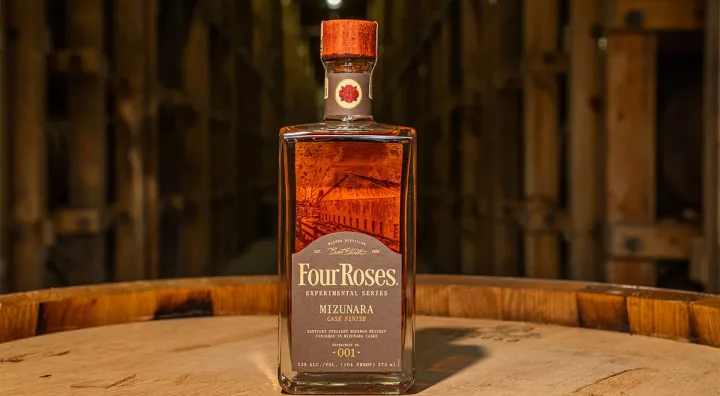
Four Roses is opening a new path within American bourbon with the launch of an experimental series focused on finishes, woods and techniques that can offer a different reading of its classic style. The first release in this collection relies on an unusual choice for Kentucky: finishing in Japanese Mizunara oak casks.
The news is significant not only because it uses a coveted wood in the whisky world, but also because it involves a distillery especially known for its ten-recipe system. Four Roses traditionally works with a combination of two mashbill profiles and five proprietary yeasts, a production architecture that allows it to build bourbons with distinct nuances while preserving a shared identity.
A series designed to go beyond the classic recipe
The Experimental Series was created as a space for trial and exploration within Four Roses. It is not presented as a break from its regular bourbon, but as a way to apply its technical foundation to less conventional formats. In this case, the focus falls on cask finishing, a practice increasingly present in the global whisky scene and one that has gained ground in bourbon in recent years.
Finishing involves transferring an already matured whisky to another type of vessel for an additional period. This second contact with wood can add new aromatic layers, alter the texture or emphasise certain traits of the distillate. In a category such as Kentucky Straight Bourbon, where the initial use of new charred oak is essential to its character, any later finish requires precision so as not to blur the original personality.
According to information provided by the brand, the Four Roses team closely monitored the evolution of the casks throughout the process, with frequent tastings to decide the point of balance for each one before the final blending. That detail matters: Mizunara can be expressive, but also unpredictable, and its influence does not always appear in a linear way.
Why Mizunara oak attracts so much attention
Mizunara oak, naturally associated with Japanese whisky, is a difficult wood to work with. Its slow growth, porosity and limited availability explain why it is a scarce resource, generally reserved for high-value projects. In aromatic terms, it is often linked to spice, fine woods, incense, coconut, sandalwood or very subtle sweet nuances, although the result depends on the age of the whisky, the toast of the cask and the length of contact.
In bourbon, its use is particularly interesting because it meets a base marked by vanilla, caramel, sweet corn, new-oak spice and, at times, ripe fruit. The challenge is to ensure that the Japanese cask brings depth without covering the warm, spicy profile consumers expect from Four Roses.
The choice of the OBSK recipe
For this first release, Four Roses has worked with a six-year-old OBSK recipe. In the distillery’s internal language, each code identifies a specific combination of mashbill and yeast. This system is one of the house’s defining features and makes it possible to select recipes that behave differently during maturation and blending.
The choice of OBSK points to a profile capable of engaging with the spice of Mizunara. Without making fixed sensory promises, one might expect a bourbon in which the wood adds further complexity to a structure of grain, sweetness and spice. The key, as with any finish of this kind, will be integration: ensuring the Japanese cask does not act as an exotic addition, but as a coherent layer within the whole.
Innovation without losing the language of Kentucky
Four Roses’ move fits into a broader trend in American whisky. Major bourbon distilleries have intensified their interest in small-format editions, finishes in unusual casks and experiments with yeasts, toasts or maturation points in recent years. These releases speak to a more informed consumer, one willing to compare styles and look for bottles with a clear technical story.
At the same time, bourbon retains clearly defined rules and traditions. Corn as the majority grain, maturation in new charred oak and the influence of Kentucky’s climate remain essential elements. That is why the most convincing innovations tend to be those that widen the range without turning the product into something unrecognisable.
In the case of Four Roses, the experimental series rests on a long history, with distillation in Lawrenceburg and ageing linked to its warehouses in Kentucky. The brand has built much of its prestige around the consistency of its recipes and the precision of its blending. That background gives it room to explore, but also places a responsibility on it: any departure still has to sound like Four Roses.
A release worth watching closely
The first release in the Experimental Series is presented in a 375 ml format and, according to the distillery’s communication, will be linked to its visitor center. Beyond its specific availability, the interest for enthusiasts lies in what it signals: a stage in which Four Roses appears ready to use its recipe system as a platform for more visible experiments.
For those following the evolution of bourbon, the Mizunara finish represents a meeting point between two whisky cultures. On one side, the structural power of the Kentucky distillate; on the other, a Japanese wood famous for its aromatic elegance and technical difficulty. If balance is achieved, the result could offer a different reading of bourbon without leaving its essence behind.
Four Roses Experimental Series therefore arrives at a time when the category is looking for new ways to converse with consumers. It is no longer enough to talk about age, cask or strength: every release has to explain why it exists and what it adds. In this case, the answer seems clear: to explore the limits of bourbon from a distillery that knows its starting point very well.