
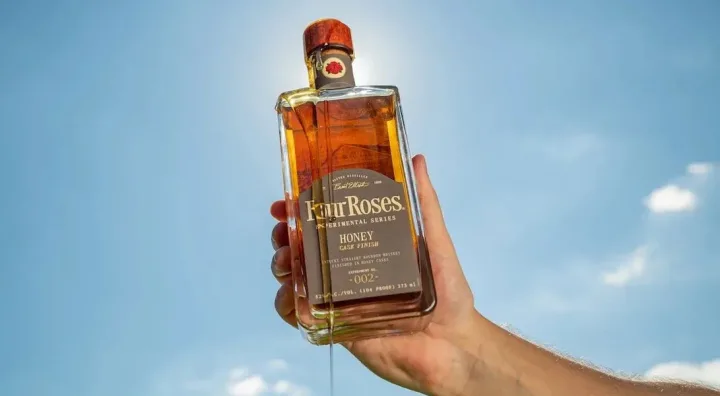
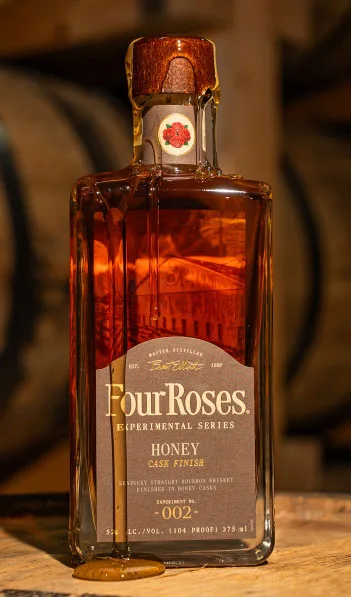
Four Roses is once again placing the cask at the heart of the conversation with a new release in its more experimental line. After announcing in June a special edition finished in Mizunara casks, the Kentucky distillery has unveiled Four Roses Experimental Series No. 002 – Honey Cask Finish, a Kentucky Straight Bourbon featuring a finish in casks that had previously held bourbon-aged honey. The idea is not to break away from the house style, but to explore how an unusual use of wood can add aromatic nuance without altering the brand’s recognisable character.
This second release in the Experimental Series is built around bourbons of different maturation ages and is presented as a limited edition directly linked to the distillery’s innovation work. What makes the news interesting is not only the launch itself, but the decision to give a second life to casks that had already played a role in another gastronomic product: honey matured in bourbon casks, created in partnership with a local producer.
Signature house yeasts
Four Roses is famous for combining two different mash bills and five unique yeast strains to create a total of 10 distinct recipes.
Four Roses Experimental Series No. 002 – Honey Cask Finish is made from a blend of two recipes: OESQ and OBSK.
OESQ:
O: Indicates that the bourbon was distilled at the Four Roses distillery in Lawrenceburg, Kentucky. (all 10 of its recipes begin with O)
E: Defines the low-rye grain recipe (mash bill), composed of 75% corn, 20% rye and 5% malted barley. It provides a distinctly sweet base thanks to the high proportion of corn.
S: Means that the distillate is a Straight Bourbon (an American standard of quality and ageing)
Q: Represents the specific yeast strain used, known for delivering a pronounced floral profile (notes of rose essence, lavender and orange blossom)
OBSK
B: Defines the high-rye grain recipe (mash bill): 60% corn, 35% rye and 5% malted barley. This 35% rye content is one of the highest percentages in the industry for a traditional bourbon.
K: Represents yeast strain “K”, which produces a markedly spicy profile with baking-spice notes (cinnamon, nutmeg, pepper).
These two blends are aged between 6 and 8 years before spending 9 months together in casks that have held honey.
A cask with a round-trip journey
The concept is especially interesting in the current context of American whiskey. In bourbon, regulations require the use of new charred oak barrels for the main maturation, making wood one of the decisive elements in the final profile. However, secondary finishes in other vessels have become fertile ground for experimentation, provided the identity of the distillate is preserved.
In this case, the cask’s journey is unusual. First it held bourbon; it was then used to age honey, which absorbed part of the wood and whiskey character; finally, it returned to the distillery to hold bourbon again during a finishing phase. That circular exchange allows the distillate to recover aromas associated with honey, but derived from contact with the cask rather than from direct flavouring.
The collaboration with Bohman Bee Company, a local honey producer, also reinforces a growing trend among distilleries: working with nearby suppliers and creating projects where gastronomy, place and distillation intersect. For Four Roses, known for its balanced, spicy style, the challenge lies in integrating that honeyed dimension without turning the bourbon into an overly sweet product.
The framework of the Experimental Series
Four Roses is one of Kentucky’s most recognisable distilleries thanks to its ten-recipe system, created by combining two mash bills with five yeast strains. That approach makes it possible to craft bourbons with different profiles, from more floral and fruit-driven expressions to others that are spicier, more structured or creamier.
The Experimental Series is conceived as a space to move beyond that classic framework without abandoning it. The first release in the collection explored the use of mizunara oak, a Japanese wood highly prized in the whisky world for how difficult it is to work with and for its distinctive aromatic contribution. The new edition finished in honey casks changes direction: rather than looking to an exotic wood, it draws on a local product and the reuse cycle of barrels.
Releases of this kind reflect an increasingly visible reality in premium bourbon: knowledgeable consumers look for authenticity, but also for innovations that make sense. It is not enough to add a striking finish; there has to be coherence between the technique, the product’s story and the result in the glass.
What honey can bring to bourbon’s profile
Honey is a common descriptor in bourbon tastings, even when it has played no part in the production process. The combination of corn, new charred oak, vanilla, caramel, sweet spices and toasted notes can naturally suggest honeyed impressions. A finish in casks that have previously held honey can heighten that effect, adding a more floral, rounded aromatic layer.
According to the information shared about this edition, the profile leans towards notes of natural honey, floral nuances, baking spices and a broad finish. These descriptors fit well with the personality of Four Roses, a house that often stands out for its balance between cereal sweetness, fruit, spice and oak.
It is worth stressing, however, that a bourbon finished in honey casks should not be confused with a whiskey liqueur or a sweetened spirit. The distinction matters: here, the nuance comes from contact with wood previously impregnated with honey, not from adding honey to the final liquid.
Innovation without losing the Kentucky accent
Four Roses Experimental Series No. 002 – Honey Cask Finish joins a broader movement: the search for new interpretations of bourbon through the barrel, rather than through rupture. The category is enjoying a period of enormous dynamism, with producers exploring finishes, recipe blends, fermentations and local collaborations, yet prestige still depends on the clarity of the concept and the quality of the base whiskey.
In this case, the distillery uses a simple, recognisable story: a barrel that first served bourbon, then honey, and finally returns to bourbon. That journey neatly captures today’s sensitivity towards reuse, local craft and controlled exploration. For fans of American whiskey, it is a release that confirms how even a category as tightly regulated as bourbon can find new nuances without losing its identity.
Four Roses Experimental Series No. 002 – Honey Cask Finish will be sold exclusively at the Lawrenceburg and Cox’s Creek Visitor Centers from September 18 at 9:00 AM EST. Available in 375 ml format, limited to four bottles per person