
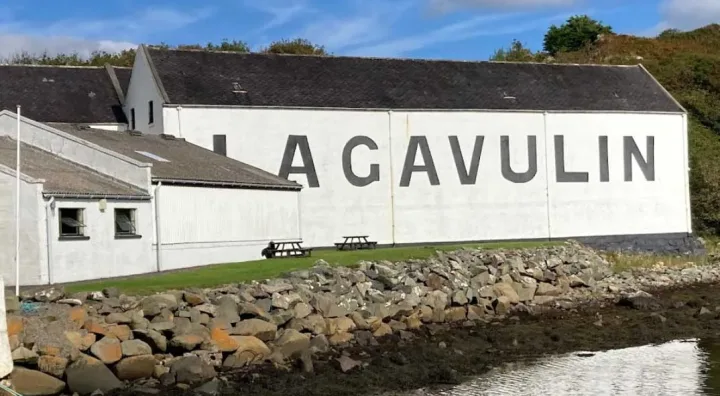
Lagavulin is a Scotch whiskey distillery founded on the south coast of Islay, between the well-known Ardbeg and Laphroaig distilleries.
Legal whiskey production in Lagavulin It began in 1816, thanks to the efforts of John Johnston, who initiated distillation in the region. Later, in 1825, the same family purchased a second piece of land near the original distillery, where another distillery was built. However, in 1837, the production of this second distillery was merged with that of Lagavulin, which gave rise to only one distillery in the area.
Since then, Lagavulin has managed to establish itself as one of the most recognized Scotch whiskey brands worldwide, thanks to its traditional distillation process and its characteristic smoky flavor.
The legacy and history of Lagavulin are reflected in every bottle they produce, and their commitment to quality and authenticity has made them one of the distilleries most admired by whiskey lovers around the world.
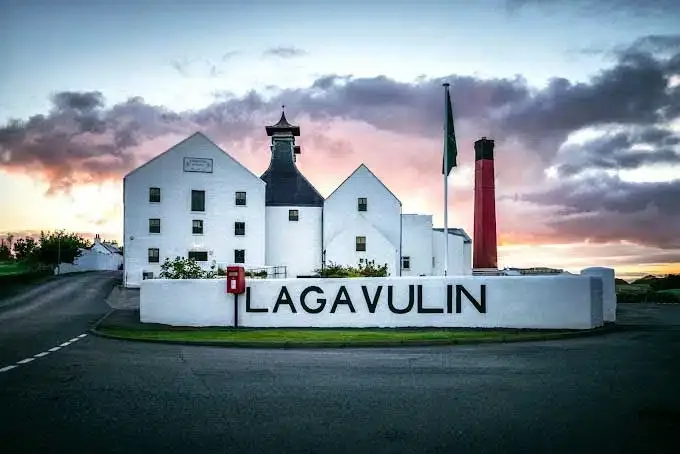
The Lagavulin distillery came to greater public fame in 1862, when whiskey blender John Logan Mackie purchased it. It was his nephew Peter J. Mackie who, after visiting Islay on several occasions from 1878 to learn the secrets of distillation, finally took over the production of Lagavulin.
In time, Peter J. Mackie became Sir Peter Mackie, one of the most prominent whiskey figures of the late 19th century. He was the creator of the blend whitehorse in 1890, co-founder of the distillery Craigellachie and is recognized as a great innovator.
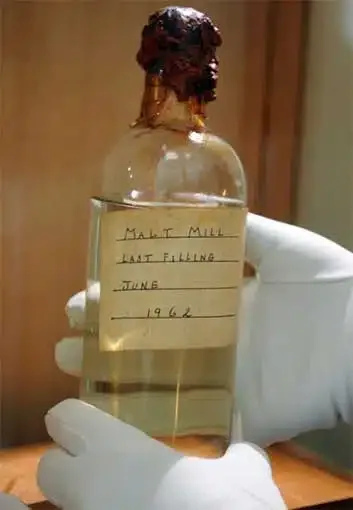
In 1908, Mackie built a replica of the distillery Laphroaig in Lagavulin, called Malt Mill which operated until 1962, and although it was designed to produce the same character as Laphroaig – which is just two miles away – it never managed to do so. It also did not produce Lagavulin. However, a (fictional) Malt Mill barrel was the central protagonist of the comedy “The Angel’s Share” by film director Ken Loach.
In 1974, the malting facility on the distillery floor was closed. Today, these facilities form the distillery's visitor center and administrative offices.
The growth of the distillery coincided with a period in which aged whiskey was scarce (1980s and early 1990s) so distribution had to be very limited.
Today, Lagavulin runs 24/7 just to try to keep up with the ever-increasing global demand. The world has fallen in love with smoke and the complex blend of coastal and moorland Lagavulin, pipe smoke, Lapsang Souchong, swamp myrtle and rich dark fruits is a destination for many.
Although fermentation times have been reduced, introducing a cereal note to the new make, the second distillation is still extremely long, maximizing reflux.
Aging occurs predominantly in filler casks, but in recent years some ex-Sherry casks have appeared as part of a controlled program of small batch releases. Additionally, a small quantity of a higher proof 12 year old whiskey is released annually for true peat lovers.
The famous Lagavulin 16 years old
When Lagavulin 16 Years Joined the Classic Malts portfolio in 1989, the belief within owner United Distillers (now Diageo) was that it would be the single malt that appealed to the most daring drinkers.
Smoke, it was felt in those early single malt days, was a step too far for most people. Glenkinchie and Dalwhinnie, softer and easier to drink, would be the big sellers.
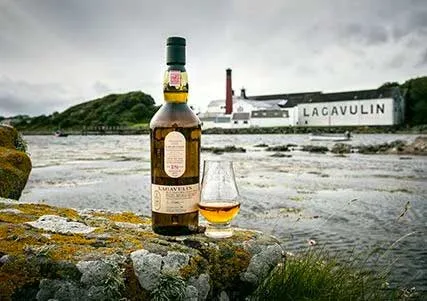
But the Lagavulin distillery defied expectations and demonstrated that smoke could be a desirable element in whiskey. Its characteristic smoky flavor became a hallmark and a key element of its success. As consumers ventured into the world of single malt whiskey, many discovered that Lagavulin was their favorite.
Today, Lagavulin is a highly respected name in the whiskey world and its 16 Years is an iconic whiskey that remains highly sought after.
Thick and heavy, Lagavulin's signature style is rich and meaty, reminiscent of smoky bacon. Using barley malted at around 35 ppm and a relatively short fermentation time, the real secret to creating this heavy spirit lies in the distillation.
Filling the stills around 90%, which dramatically reduces the amount of copper contact and reflux, creates meaty notes in the freshly made whiskey that, upon aging, become the heavy flavors that make up the core of the whiskey.