
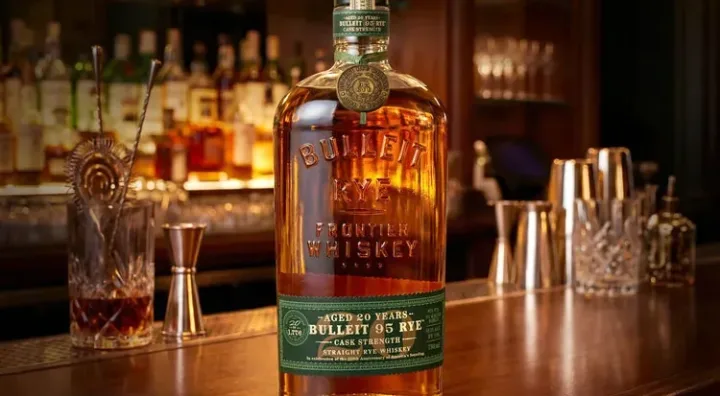
American rye whiskey has been enjoying a renewed golden age for years, driven by classic cocktails, growing interest in spicy flavor profiles and the revival of styles that once seemed pushed to the margins of bourbon. Against that backdrop, Bulleit Frontier Whiskey has announced a particularly meaningful move: a 20-year-old straight rye whiskey, the oldest release ever issued by the brand.
The expression, intended for the US market, is presented as a very limited edition with significance beyond simple collectability. Bulleit, one of the names that has done most to popularize modern rye, is using this bottling to reaffirm the foundational role of rye in North American whiskey culture.
A long-aged rye in a demanding category
Rye whiskey does not age in the same way as bourbon. Its naturally drier, spicier and more direct profile can gain depth over time, but it also risks being overtaken by oak if maturation is pushed too far. That is why a rye whiskey rested for two decades calls for especially careful barrel selection.
In Bulleit’s case, the brand’s identity is closely tied to a recipe with a very high proportion of rye. That style has been central to its presence in bars and cocktail programs, where it performs confidently in drinks such as the Manhattan, the Old Fashioned and the Sazerac. Taking that foundation into a 20-year-old expression raises an interesting question: how much of the grain’s spicy tension can remain after such prolonged contact with American oak.
According to information released about the launch, the whiskey was distilled in Lawrenceburg, Indiana, and later aged in Kentucky. It is bottled at barrel strength, without significant dilution, reinforcing its character as a release aimed at experienced enthusiasts and collectors.
The importance of the barrel in a 20-year-old rye
In American whiskies, new charred oak barrels quickly contribute vanilla, caramel, sweet spice, coconut, toasted notes and tannins. Over an extended maturation, those elements can become very intense. The skill of the selection team lies in identifying barrels that have evolved with balance: oak that is present, certainly, but not enough to erase rye’s essential edge.
In a rye of this kind, one might expect a darker, deeper profile than in younger expressions: dried fruit, baking spices, seasoned oak, cocoa, dense caramel and a lingering finish. The key, however, is not only intensity, but the architecture of the whole. A good old rye should still show dryness, a spicy cut and a certain aromatic energy.
Oversight of this type of blend is usually decisive. It is not simply a matter of finding old barrels, but of identifying those that remain alive after years of evaporation, concentration and climatic shifts in the aging warehouses. In Kentucky, temperature swings encourage a very active interaction between whiskey and wood, something that can accelerate both complexity and the risk of over-extraction.
Bulleit and the revival of rye whiskey
For much of the 20th century, rye whiskey occupied a quieter place alongside bourbon’s growth. Its historical importance, however, is immense. Before bourbon became established as the great emblem of American whiskey, rye was a common raw material in several areas of the country’s Northeast and was part of everyday life in taverns, distilleries and cocktail recipes.
Prohibition marked a deep rupture for many distilling traditions. Decades later, the resurgence of classic cocktail culture brought rye back to the foreground. Bartenders were looking for whiskies with a drier, spicier structure in order to recreate historic recipes with greater fidelity. Brands such as Bulleit found fertile ground there: a recognizable spirit with character, yet also versatile behind the bar.
The release of a Bulleit Rye 20 Year Old fits neatly into that narrative. It not only extends the range toward a high-age expression, but also reinforces the idea that rye is no longer a secondary category. In fact, it is one of the most interesting areas of American whiskey today.
A limited edition with historical resonance
The edition has been linked to the anniversary of the founding of the United States, with a very small run and numbered bottles. Releases of this kind tend to draw collectors’ attention, but they also serve as a reminder that rye whiskey is part of the country’s liquid memory. In a market dominated for years by bourbon, revisiting rye’s story means looking back to an earlier chapter in North American distilling.
It is worth stressing that broad international distribution has not been announced. For now, the release is aimed at the United States market, with availability at the distillery and at selected locations. For European enthusiasts, that will likely make it a bottle rarely seen outside auctions, private exchanges or specialist channels.
How to approach and enjoy a high-proof rye
A rye whiskey bottled at barrel strength calls for a patient approach. It is not the kind of spirit that should be judged on the first sip. The high proof concentrates aromas, boosts texture and may need a few minutes in the glass to open up.
- Glassware: a tulip-shaped tasting glass is best, or a small tumbler for a more relaxed pour.
- Time: letting it rest for a few minutes helps alcohol, wood and spice come together.
- Water: a few drops can reveal fruit, sweetness and grain nuances without over-diluting the whiskey.
- Pairing: dark chocolate, toasted nuts, aged cheeses or smoked meats can work well with its spicy profile.
Beyond its availability, the interest of this Bulleit Rye 20 Year Old lies in what it represents: the maturity of a category that has moved from being a curiosity for insiders to holding a central place in the conversation around American whiskey. If bourbon remains the great icon, rye is increasingly claiming its own space, drier, spicier and deeply tied to the country’s history.