
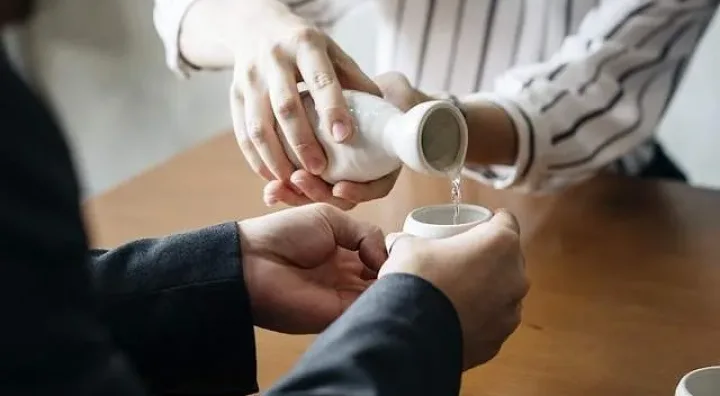
Let's learn about sake, a Japanese liquor that is gaining followers internationally. Today we will talk about its origin, preparation and service.
Although the statistics say that the per capita consumption of sake has progressively declined since the 1970s, following the opening of society to the Western world in the last century and a half, almost all alcoholic beverages from around the world have been adopted. At the beginning of the 20th century there were more than 4,600 sake producers in Japan. Currently there are 1,400.
 59 countries and regions import "nihonshu", mainly the United States (32.3% of the total in 2017) and China, with Hong Kong in the lead (15%).
While consumption has decreased internally, currently, 59 countries and regions import "nihonshu", mainly the United States (32.3% of the total in 2017) and China, with Hong Kong in the lead (15%). Let's look at some specific aspects about the origin, preparation and the way in which this delicious drink is consumed.
This drink obtained from fermented rice and whose correct name is "nihonshu" (the term "sake" means "alcoholic drink" and encompasses them all) arouses growing interest abroad while fighting for its local subsistence despite its ancient origin, linked to offerings to Shinto deities.
The origin of sake
It is not known if it comes from China either Japan.
Everything seems to indicate that several centuries before Christ they already existed in China similar liquors, which were used in religious ceremonies like rice wine, mǐ jǐu: "In the 3rd century it began to be cultivated in Japan he rice, brought from China, from West to East.
The first were called kuchikami or "sake to chew in the mouth", and was made with chewing rice; Once chewed, the starch was converted into sugar thanks to saliva, it was combined with cooked rice and was fermented, giving rise to a low alcohol sake and very thick."
In the 7th century the emperor granted the sake the status of noble and sacred, becoming part of Shinto religious ceremonies.In the 15th century, thanks to the discovery of double sowing sake begins to be made in large tanks, raising the sake making and beginning to resemble the sake we know today.
With the Meiji restoration will grow exponentially the number of factories sake, then taxes on alcoholic beverages were increased and home brewing was prohibited, reducing the number of sake producers.
At the beginning of the 20th century, the institute of Sake Making Research which will collaborate in the research and development of sake and will carry out tastings of it.
The sake making
The makers of this drink are known in Japan as "Touji" and sake factory workers are known as "Kurabito".
The process of elaboration of thesake has been improved over the centuries and consists of 9 phases:
- Polishing and grinding rice (Seimai): It is a process where the rice is dropped vertically between two stones that rotate in the opposite direction and grind it, extracting the unwanted dust Through this process, proteins and components that can cause the loss of flavors are eliminated.
- Washed or soaked: The grains are first washed to remove dust in a process called Senmai.
Later, the rice grains will be allowed to rest with water so that they soak.
- steam cooking: Once the rice has absorbed 30% of the water from the container, the rice is placed in a container called Koshiki and it is cooked, through the contact of the steam with rice.
This container used to be made of wood and the steam came through a hole in the bottom.
- The production of the Kōji: It is called Koji to cooked rice on which Aspergillus Oryzae (Koji-kin) spores are deposited, cultivating a mold that secretes enzymes on the rice grains that convert starch into sugar.
The development of this process lasts 40 to 64 hours and will give the sake dryness, sweetness and aromas.
- Shubo Preparation: So that the yeast can activate, a preparation is made with steamed rice, water, Koji, and yeast for 2 or 3 weeks, which will allow the yeast to survive in the fermentation process.
- Preparation of Moromi and Sandan Shikomi: In the fermenter tank we will add 30% Koji and the rest of cooked rice, obtaining the Moromi.
After adding the Shubo al Moromi will begin the sake fermentation process. He Sandan Shikomi It is a procedure to adhere the different preparations in steps that lasts 4 days, on the first day the Shubo is added to the Moromi and left another day for the yeast to multiply; On the third day, twice as many Moromi and Koji are added, and on the fourth day, twice as many Moromi and Koji will be added as on the third day.
After mixing, it will be left rest between 18 and 32 days for it to ferment well.
- Pressing: also known as Jose It is the process by which the Moromi is pressed once it has been fermented using a mesh that will separate the sake of the fermented rice.
- Filtration: It is also known as Roka and is made after the sake has rested for 10 days, filtering he sake with coal dust. The use of coal dates back to 1930.
There is also unfiltered sake, which is becoming very popular in recent years and is called Muroka.
- Pasteurization and traffic jam or Hi-ire: There are two ways to pasteurize sake, once bottled or before bottling. To pasteurize sake, it is heated to 65 degrees, or once it has been bottled, the bottle is immersed in hot water. Before using pasteurization, the sake in cold places so that it does not lose its aroma and flavor.
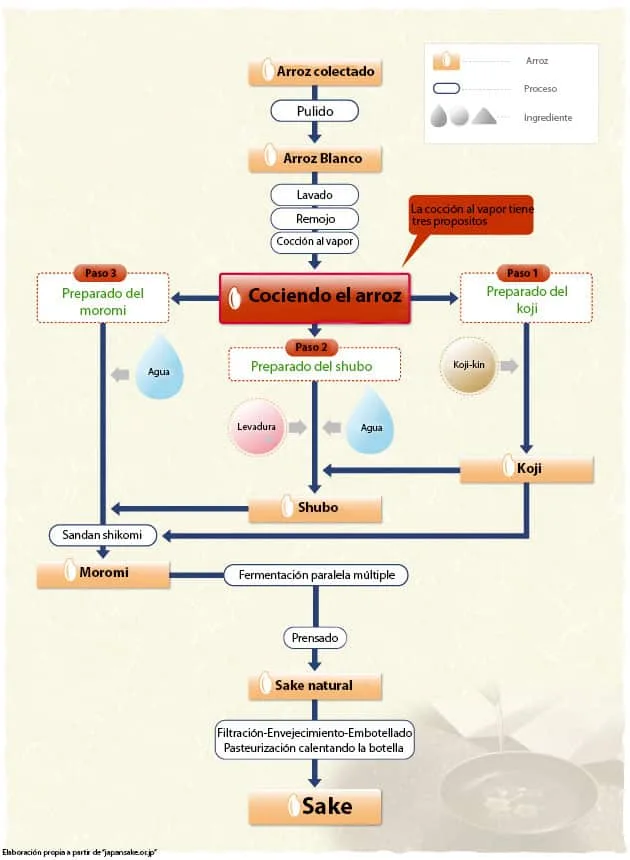 Preparation method.
In Japan there is no Denomination of Origin, as is the case with Spanish wines, but there are different provinces or prefectures in which it is manufactured. In total there are 47 Japanese provinces that offer the best sake in the world. Each type of drink offers very different flavors and nuances, which are conquering the Spanish consumer.
What varieties of sake there is?
There are four types:
- Honjozu: in which a little distilled alcohol is added during the process to enhance its flavor and aroma.
- Junmai: It has a polishing of at least 20%. It is characterized by a stronger flavor and acidity.
- Ginjo: with more fruity and floral flavors. The polishing of the rice increases to 40% and a little distilled alcohol is added at the end of the process.
- Daiginjo: more valued and more complex. The polishing of the rice exceeds 50%, and can reach 80-90%.
When to a Ginjo either Daiginjo the term precedes it Junmai It means that distilled alcohol has not been incorporated in the production process.
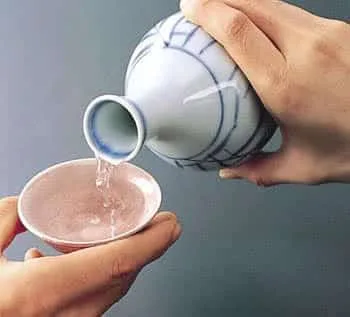 It can be taken hot or cold. It is best to store it at a cold temperature (between 5 and 10 degrees Celsius), in a dry place where direct sunlight does not shine.
How to taste it?
- It can be taken hot or cold. It is best to store it at a cold temperature (between 5 and 10 degrees Celsius), in a dry place where direct sunlight does not shine. However, it is possible to consume it up to 55 degrees Celsius, depending on the type of product.
- Its alcohol content is not very high because it is a fermented drink. Generally, there are about 15 degrees of alcohol that are hidden in each bottle, something very similar to wine.
You may be interested in this video: