
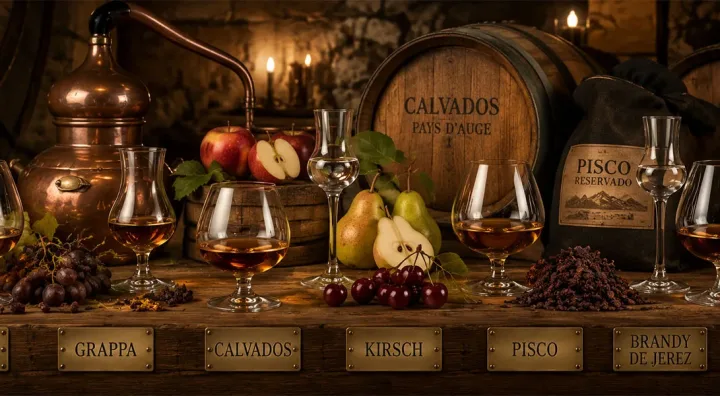
The word brandy is often used as if it referred to one specific drink, but in reality it covers a broad and diverse family of spirits. The term brings together spirits made from grapes, apples, pears, cherries, grape pomace from winemaking and even other fruits. Some are aged for years in wood; others are bottled young to preserve the full expression of the raw ingredient. And within that diversity, certain names have an identity of their own: Cognac, Armagnac, Calvados, pisco, Brandy de Jerez, grappa or orujo, among others.
Understanding the different types of brandy makes it easier to read a label, choose a glass after a meal or appreciate why two spirits that seem closely related can taste so different. The key lies in three factors: the raw material, the place of origin and the production method.
What exactly is brandy?
In general terms, brandy is a spirit distilled from fermented fruit. In the European imagination it is usually associated with distilled wine, especially grape wine, but the category is broader than that. When apple cider is distilled, for example, it is also a fruit brandy; when the solid remains of winemaking are used, we enter the world of pomace spirits.
The word comes from the commercial world of “burnt wine” or distilled wine, a practice that made it possible to concentrate alcohol, ease transport and improve preservation. Over time, barrel ageing revealed that these spirits could gain complexity, texture and aromas of dried fruit, spice, vanilla, cocoa and fine wood.
Cognac: the French brandy with its own rules
All Cognac is brandy, but not all brandy is Cognac. The difference is not merely semantic: Cognac is protected by a French appellation of origin and must be produced within a defined area around the town of Cognac, in western France. Its production is also subject to specific rules on grape varieties, distillation, ageing and quality control.
The most common grape is Ugni Blanc, valued for its acidity and its ability to produce light base wines that are ideal for distillation. Cognac is traditionally distilled in copper pot stills and aged in French oak. Then comes an essential stage: blending. Cognac houses combine different spirits, known as eaux-de-vie, to achieve a consistent profile or a particular expression.
The best-known age statements help to interpret the label. VS, VSOP and XO indicate the minimum ageing time of the youngest component in the blend, although many producers work with spirits that are older than the required minimum. Beyond age, the origin of the grapes within the different production zones also shapes the final character, from more floral, elegant styles to rounder, more structured profiles.
Armagnac and Calvados: two French classics with personality
France does not end with Cognac. In Gascony, Armagnac offers a more rustic, deeper interpretation, often more closely tied to the individual producer. Although it also begins with white grapes and shares certain age statements, its production usually relies on traditional continuous distillation and on a culture in which vintages play a greater role. This is why it is common to find Armagnacs from a specific harvest year, an option highly prized by enthusiasts seeking individuality.
Calvados, meanwhile, comes from Normandy and is made from apples, although some areas also allow the use of pears. Its base is cider, which is distilled and aged in wood. The result can range from a fresh spirit with notes of ripe fruit and apple peel to more evolved expressions with hints of compote, sweet spices, dried fruit and polished oak. It is one of the clearest examples of how brandy is not defined by grapes alone.
Brandy de Jerez: Spanish identity and solera ageing
In Spain, Brandy de Jerez holds a prominent place. Its personality is closely linked to the Sherry Triangle and to the use of casks that have previously held Sherry wines. This ageing process gives it highly recognisable nuances: raisins, walnuts, vanilla, cocoa, wine-seasoned wood and a rounded, enveloping feel on the palate.
The criaderas and solera system, also used for Sherry fortified wines, makes it possible to blend spirits of different ages dynamically in order to maintain a consistent style over time. Rather than highlighting a specific vintage, this method is about building continuity, complexity and balance. For many Spanish consumers, Brandy de Jerez has historically been the gateway into after-dinner spirits.
Pisco: South America’s cocktail brandy
Pisco is a grape spirit with deep roots in Peru and Chile, two countries with their own traditions and regulations. Its character depends on the grape varieties used, the production method, and whether the distillate is kept in neutral vessels or spends time in wood, according to the style and the applicable legislation.
In the glass, pisco usually shows a more direct expression of the grape than other aged brandies. It can be floral, fruity, spicy or more wine-like, and its versatility has made it a star of both classic and contemporary cocktail culture. The Pisco Sour is its most famous cocktail, but it is far from the only setting for this spirit, which also works well in long drinks, citrus-led mixes and fresh-style cocktails.
Grappa, orujo and other pomace spirits
Not all brandies are made from fermented wine as such. Pomace spirits are produced from the solid remains of grapes after winemaking: skins, pulp, seeds and, depending on the case, stems. Far from being a lesser by-product, this family has given rise to drinks with a strong local identity.
Italian grappa is probably the best known internationally. In Spain, orujo has a long-standing tradition, especially in winegrowing areas of the north. In France it is known as marc, while other countries have equivalent expressions. These spirits may be clear and unaged, with an intense, varietal character, or aged in wood, where they gain smoothness and toasted notes.
Eaux-de-vie: the purity of distilled fruit
The term eau-de-vie can be confusing because, in the world of Cognac, it is used to refer to the spirits that will later form part of a blend. In a broader sense, however, it describes fruit spirits that are usually unaged or show very little influence from wood.
Across Central and Eastern Europe, pear, plum, cherry, apricot and raspberry spirits are common, each with traditional names depending on the country. Their appeal lies in their aromatic clarity: the fruit comes through without the filter of oak, with an intensity that may be delicate or sharp. Served chilled, in small glasses, they form part of many regional food cultures.
How to choose and enjoy brandy
The best way to drink brandy depends on the style. Young, fruit-driven spirits often benefit from cooler temperatures and small glasses. Aged brandies, by contrast, tend to show better in a tulip glass or copita, without excessive warming, so the alcohol does not overpower the aromas.
More than a single drink, brandy is a map of traditions. It brings together wine regions, orchards, stills, barrels and after-dinner customs. Anyone approaching the category with curiosity will find styles that differ widely from one another, from the elegance of Cognac to the freshness of pisco or the depth of Brandy de Jerez. That diversity is precisely its greatest appeal.