
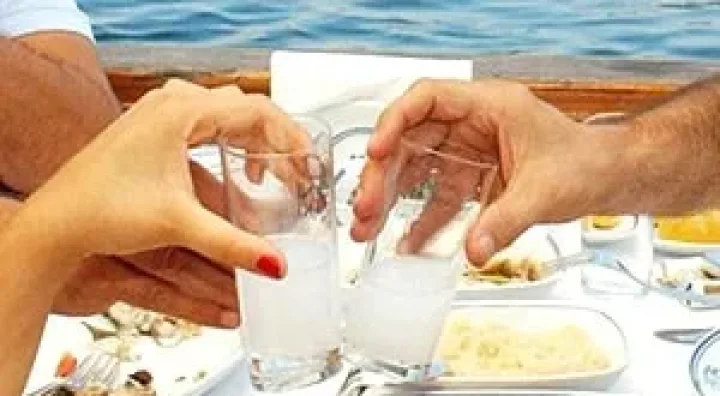
Traditional raki production is based on the fermentation of raisins, although raki made from fresh grapes and figs is also popular
Raki, or “lion’s milk”, is Turkey’s national drink, made from what remains of grapes after winemaking. It is called that not only because of the milky colour it takes on when mixed with water, as it is traditionally drunk, but also because of its high alcohol content.
It is similar to several alcoholic drinks found around the Mediterranean and parts of the Balkans, such as anise, pastis, sambuca, arak, ouzo, tsikoudia, tsipouro and mastika.
 It is similar to several alcoholic drinks found around the Mediterranean and in parts of the Balkans.
It is drunk with Turkish starters or meze. It is generally mixed with an equal part of water. When water is added, the mixture turns whitish, which is where the drink gets its well-known nickname, Aslan Sütü, meaning “lion’s milk”.
In restaurants, the most common bottles are 20 cl, 35 cl and 70 cl. To give an idea, a 35 cl bottle is enough for 4 double rakis, called duble, or 8 single serves, called tek. How much does it cost? Alcohol in Turkey is not cheap, as taxes are high. Bottle prices depend above all on the type.
The origins of the liquor
Although the etymological origins of the word raki are somewhat uncertain, it is said to derive from arak, which in Arabic means sweat. Other theories place the origin of the drink in Iraq, with the word deriving from iraki.
Raki was popularised during the Ottoman Empire. It is believed that the drink arrived in Istanbul in the 17th century. Until then Turks drank wine, and it was not until the 19th century that raki replaced it in everyday life and became the national distillate.
 It was popularised during the Ottoman Empire, and the drink is believed to have reached Istanbul in the 17th century.
Until the 19th century, during the Ottoman Empire, meyhanes, traditional Turkish restaurants, usually served wine with mezzes because of religious rules imposed by several sultans. Attendance at these restaurants, however, was often subject to punishment by sharia authorities.
During the Tanzimat period, a period of renewal in the Ottoman Empire, attendance at these places increased and they became popular among customers. Raki became so popular that by the end of the century it had replaced wine in consumption.
Production
In the classic production system, raisins are chopped and placed in vats for later fermentation. Water is then added and the fruit is left to soak. The next step is to add yeast to trigger fermentation.
In about five days the sugar has turned into alcohol and a mash of around eight degrees of alcohol is obtained. During the first distillation, a liquid with a high alcohol percentage is obtained, known as soma. Anise seeds and water are then added to the soma, and it is distilled for a second time.
 Because of its high alcohol strength, around 45 degrees, it is usually consumed mixed with water.
The resulting liquid is diluted again with water, a light touch of sugar is added, and it is stored for two months in barrels. After this process, it is ready to be bottled.
Ways to drink it
Generally, because of its high alcohol strength, around 45 degrees, it is consumed mixed with water and with the already mentioned mezze, most commonly accompanying dinner.
The most usual way to drink it is very cold, around 8 degrees. In a smooth cylindrical glass, half is filled with liquor and the other half with water. A separate glass contains only water, so one takes a sip of the liquor and then a sip of water.
If ice is added, it is important to add it after the water, otherwise the liquor crystallises and the aromas break down. It is crucial to respect the rules of the ritual:
- Never drink it on an empty stomach. Raki is always drunk with food. And do not even think of doing a “fondip”, drinking it in one gulp.
- Never drink it neat; it is always drunk with water.
Types of Rakı
Standard Rakı is a grape product, although it can also be produced from figs. The fig-based version is especially popular in the southern provinces of Turkey and is called incir boğması, incir rakısı, or in Arabic, Tini.
Suma Raki, meaning the distillate before the addition of anise, is generally produced from raisins, but wine-spirit factories established in wine-producing areas such as Tekirdağ, Nevsehir and Izmir can also use fresh grapes to obtain a high-quality drink.
 Never drink it on an empty stomach.
Recently, Yas Uzum rakısı, fresh grape Rakı, has become more popular in Turkey. A recent brand, Efe rakı, was the first company to produce Raki exclusively from fresh grape juice, called Efe Yas Uzum Rakısı, Efe fresh grape Rakı. Tekirdağ Altın Seri, Tekirdağ Gold Label, followed the trend, and many others have been produced by other companies.
The best-known and most popular raki brands, however, remain Yeni Raki, originally produced by Tekel, which transferred production rights to Mey Alkol with the 2004 privatisation of Tekel, and Tekirdağ Rakısı from the Tekirdağ region.
You may also be interested in: