
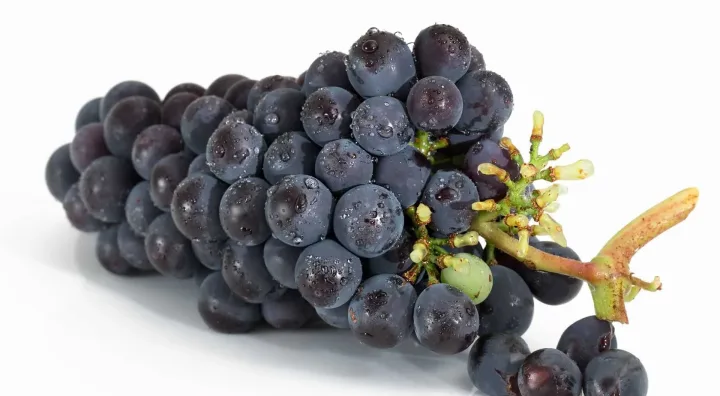
Grape morphology helps us understand the result of winemaking; here are the details to explore
The grape contains within it all the elements required for wine production. If you are beginning to enter the world of wine, or if you are simply curious, this article on grape morphology is worth reading, because this information helps explain the final result found in the glass.
 Learn about grape morphology, whether the fruit has white or purple pulp and a sweet flavour. Besides wine and raisins, grapes are consumed fresh and as juice.
The grape is the fruit formed in clusters on the vine. It is used worldwide for fermentation, since fermentation gives rise to wine. Grown in vineyards, grapes develop grouped on vines, with between 6 and 300 grapes per bunch. With white or purple pulp and a sweet flavour, the grape is consumed fresh and as juice, in addition to its industrial uses in wine and raisins.
The grape is attached to the stem, or rachis, through the pedicel, a small and firm plant segment. Grapes are used not only as table fruit, but also to make many drinks and products such as verjuice, must, brandy, cognac, armagnac, pisco and vinegar. They may be black, purple, yellow, golden, pink, orange or white, although white grapes are actually green and, evolutionarily, come from red grapes with a mutation in two genes.
This mutation means they do not develop anthocyanins, the polyphenols that produce red pigmentation and help prevent the fruit from freezing. Most cultivated grapes belong to the species Vitis vinifera, native to Mediterranean Europe and Central Asia.
Grape morphology: the parts
- Grape morphology - the pulp: the pulp represents 80-85 percent of the total weight of the bunch and contains the main components discussed later: above all water and sugars, which after fermentation will be transformed into alcohol, together with more than 700 chemical compounds. It also contains acids, mineral salts, pectins, vitamins, nitrogenous substances and enzymes.
- Grape morphology - the seeds or pips: two or more pips usually appear in each grape, depending on the variety. They are found symmetrically in the centre of the berry and represent only about 3 percent of the bunch by weight. They have a very hard outer layer, add technical complexity to wine and are rich in oily substances.
- Grape morphology - the skin: the skin is the outer layer of the grape and contains the seeds and pulp inside. It is a thin, waterproof, insulating and resistant layer that helps protect the fruit externally. The skin accounts for around 8 percent of the bunch weight and contains cellulose, pectin, proteins and tannins. Above all, it contains aromatic substances on the inner face of the skin and colouring substances, the polyphenols: flavones, which give green grapes their colour, and anthocyanins, which give red grapes their colour. On the outer face of the skin is the bloom, whose function is to contain the internal liquid and the pips; yeasts settle there and later help ferment the must.
Let us look at these parts in the following image:
 Grape morphology: the parts.
What does the soil where the grape is grown contribute?
In grape morphology, around 80 percent of the grape is water, while the remaining 20 percent is made up of polypeptide amino acids and proteins, which account for about 0.5 percent and contribute to the activation of alcoholic fermentation. Carbohydrates, which represent around 18 percent, act as nutrients for the yeast.
The soil also contributes minerals to grape morphology, such as phosphorus at 11 percent and 5 percent, as well as sulphur, potassium, magnesium, iron, sodium, copper and zinc, among others. Vitamins present in grapes, such as thiamine, riboflavin, niacin and ascorbic acid, act as essential growth factors for yeasts and bacteria.
 In grape morphology, 80 percent of the grape is water, while the remaining 20 percent is made up of polypeptide amino acids and proteins.
The most important taste groups
Because it is useful to know which components come from the grape and which belong to winemaking processes such as maceration, fermentation or ageing, we can look at the most important taste groups:
- Sweet: the substances from the grape responsible for sweetness are sugars, including components such as glucose, or pentoses such as fructose and xylose, and polyalcohols. Those coming from fermentation are alcohols. Grapes contain between 15 and 25 percent sugars made up of fructose and glucose. Grapes contain hardly any sucrose, and it disappears during fermentation. Alcohols add nuances to the sweet taste of wines. After water, which represents 80 percent, ethyl alcohol or ethanol is the most important component among wine substances.
- Acid: the substances that give the grape its acidic taste are: 1) from the grape: tartaric acid, malic acid and citric acid; 2) produced during fermentation: succinic, lactic and acetic acid. The latter is what is known as the volatile acidity of wine.
- Salty: among the substances responsible for salty taste are: 1) salts of mineral acids, such as phosphate sulphate and chlorides; 2) salts of organic acids.
- Bitter: the substances responsible for bitterness are polyphenols. Their bitter sensation is accompanied by astringency. Tannins are the main cause of the astringency found in the skins, pips and stems of grapes.
Inside the vine are all the elements required for winemaking, which is why understanding grape morphology can help explain the final result. The way the grape is crushed can affect the organoleptic properties of the must. For example, if it is pressed lightly, sugars are extracted from the centre of the grape and few polyphenols are obtained, which is useful for fruity white wines. If the pressing is stronger, tannins begin to be extracted and red colouring appears.