
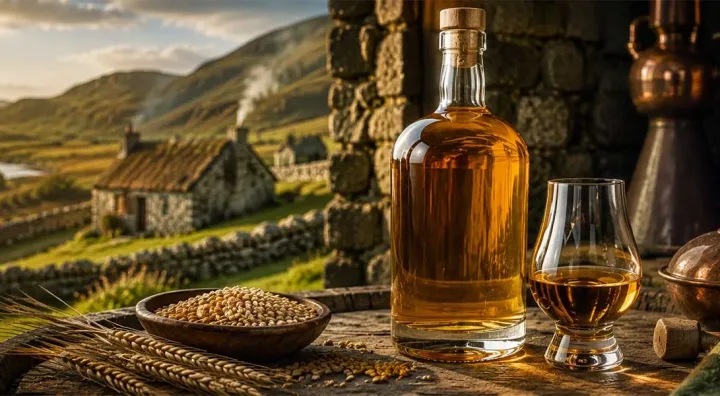
Irish whiskey is going through a period of redefinition. After years of international growth and the emergence of new distilleries, Ireland is considering an update to the technical specifications that govern some of its most emblematic categories. The debate is far from minor: it affects the way Irish pot still whiskey, one of the country’s historic hallmarks, is understood.
The review put forward by the Irish authorities has received input from various industry organisations, including bodies representing whiskey producers and professionals. At the heart of the discussion lies a classic question for any drink with a strong tradition: how far can a definition be broadened before its identity starts to lose focus?
Irish pot still, a category with a history of its own
Irish whiskey has several recognisable families: malt, grain, blended and pot still, among other commercial styles. Of all of them, pot still holds a particularly distinctive place because it combines malted barley and unmalted barley, a practice linked to Ireland’s production history and to the spicy, creamy, cereal-led character that many enthusiasts associate with this style.
The current regulations set minimum levels for both malted and unmalted barley in the cereal mash, while placing tight limits on the use of other grains. The proposed update would make more room for cereals such as oats, wheat or rye. The aim is not to turn pot still into a category with no points of reference, but to allow producers to work with a broader raw-material palette, one that is closer to certain historical recipes while also offering greater flexibility for contemporary distillation.
That point is essential. The modern image of Irish whiskey was consolidated over decades in a highly concentrated industrial context, with only a few houses producing much of the volume. Today the landscape is different: smaller-scale distilleries have appeared, old practices have been revived, and there is greater interest in exploring less uniform aromatic profiles.
More grains, more nuance
The option to use a higher proportion of cereals other than barley could have meaningful sensory consequences. In distillation, grain does more than provide fermentable yield; it also influences the texture, aromas and structure of the spirit before it enters wood.
- Oats: often associated with a creamy mouthfeel, softness and notes of sweet cereal.
- Wheat: can bring roundness, lightness and an approachable profile, with a less spicy impression.
- Rye: introduces a firmer character, with hints of spice, toasted bread and a certain dryness.
In the context of Irish pot still, these grains would not necessarily be a modern break with tradition. Several producers have shown interest in reviving cereal blends inspired by old documents, from a time when recipes could vary according to availability, local economics or the customs of each house. The category, therefore, sits between two forces that are not always contradictory: innovation and a return to practices that predate standardisation.
The debate around casks
Another aspect of the review concerns how maturation is described. Irish whiskey, like other major world styles, owes its complexity not only to grain and distillation, but also to ageing. Traditionally, oak has been the benchmark material for casks, with a dominant role played by vessels that previously held bourbon, sherry or other wines and spirits.
The proposal under consideration would remove a strict reference to oak from certain technical texts. Changes of this kind should be interpreted with caution: they do not mean that oak is going to disappear from Irish whiskey, but rather that regulatory wording may be seeking a less restrictive formulation. For many distilleries, the cask remains an area of controlled experimentation, with combinations of woods, origins and previous uses that shape colour, aroma and mouthfeel.
In recent years, the category has embraced finishes in wine casks, sherry butts, Port pipes, rum casks and new oak with varying levels of toasting. That diversity is part of Irish whiskey’s current appeal, although it also calls for clear rules to protect the credibility of the geographical indication.
Tradition versus administrative definition
Drinks covered by a protected designation or indication always exist in a balance between memory and interpretation. If the rules are too narrow, they can freeze a snapshot of one particular moment and exclude earlier practices or legitimate developments. If they are too broad, the category risks losing its meaning.
The case of Irish whiskey is especially interesting because the sector’s revival has coincided with a more curious look at the past. New distilleries have researched old recipes, production records and styles that predate industrial concentration. Major brands, for their part, have also shown interest in releasing expressions inspired by historical documents or traditional methods.
This movement should not be seen solely as a commercial strategy. It reflects a wider trend in the whisky world: specialist consumers increasingly value transparency around grain, distillation, still type, cask and origin. In that context, regulations that recognise historical diversity can make more precise labelling possible and help create products with greater personality.
What it could mean for consumers
For enthusiasts, these changes could translate into a more varied offer within Irish whiskey. Pot still would continue to be identified by its link to malted and unmalted barley, but it could show a broader range of profiles: spicier, creamier, lighter or more rustic, depending on the mash composition and each distillery’s approach.
Interest in comparing styles is also likely to grow. A classic-profile single pot still, made predominantly with barley, will not express itself in the same way as one with a notable presence of oats or rye. Maturation will also continue to create decisive differences: ageing focused on ex-bourbon casks is not the same as a combination with sherry butts or new oak.
The key will be clarity. If the industry uses this review to communicate more effectively how its whiskeys are made, consumers will benefit. If, on the other hand, greater flexibility leads to confusing messages, the category could lose some of the sharpness it has built in recent years.
A decisive moment for Irish whiskey
The review of Irish whiskey rules comes at a point of maturity for the industry. The category no longer needs to present itself simply as a smooth alternative to scotch or bourbon. It has history, distinctive styles, ambitious producers and a growing base of consumers interested in the details.
Widening the scope for pot still and refining the language around casks could be an opportunity to better reflect the reality of contemporary Irish whiskey: more diverse, more aware of its past and more willing to explore. The challenge will be to maintain a recognisable identity while allowing each distillery to find its own voice.