
Within the vast world of whisky, few categories are as closely tied to one country as Irish single pot still. This is not simply whisky made in Ireland, but a style with its own rules, a history shaped by taxation, international trade and survival, and a sensory profile that clearly sets it apart from other grain distillates.
For many enthusiasts, Irish whiskey brings to mind approachable spirits: smooth on the palate and effortlessly enjoyable. There is some truth in that image, but it does not tell the whole story. Under the Irish whiskey umbrella sit several families: single malt, single grain, blended whiskey and single pot still. The last of these is probably the most genuinely Irish of them all.
What single pot still means
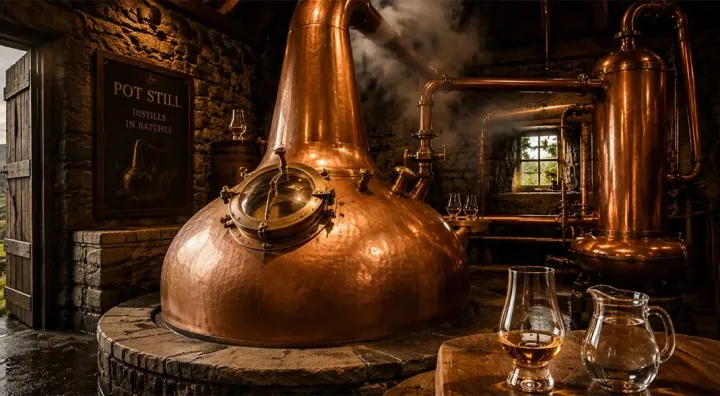
The term may sound technical, but it rests on three essential ideas. First, it must be produced at a single distillery. Second, it is distilled in traditional copper stills, known as pot stills, which work in batches rather than continuously. Above all, it uses a mix of malted barley and unmalted barley as the main base of its recipe.
This combination of grains is the key to the style. Malted barley provides the enzymes needed to convert starches into fermentable sugars, as well as sweet, bready and cereal-led notes. Unmalted barley adds another dimension: a creamier texture, spicy nuances and a more direct grain character, sometimes reminiscent of oats, fresh dough, nuts or white pepper.
Unlike Scottish or Irish single malt, which is made exclusively from malted barley, single pot still plays with that duality between malted and unmalted grain. That is why it can feel familiar to someone coming from malt whisky, yet still surprise with its mouthfeel and aromatic profile.
Current examples of pot still whiskey include Jameson Single Pot Still, Redbreast, Powers, and others.
A style born from a practical solution
Like so many drinking traditions, single pot still did not begin as a romantic choice, but as an adaptation. In 18th-century Ireland, taxes on malted barley led many producers to include unmalted barley in their mash bills. What started as an economic response eventually gave shape to a style of its own.
Over time, Irish whiskey made in pot stills achieved considerable international prestige. For decades, Ireland was a global whisky powerhouse, with distilleries exporting to key markets and enjoying enormous recognition. The 20th century, however, was especially harsh on the industry: trade disputes, the loss of export markets, Prohibition in the United States and the rise of blended Scotch whisky drastically reduced the number of working distilleries.
Single pot still, once an emblematic style, spent many years in a minority position. Its recent revival is part of the broader renaissance of Irish whiskey, driven by new distilleries, greater international interest and a growing curiosity for styles with a strong historical identity.
Copper pot stills and triple distillation
The use of copper pot stills is essential to understanding the personality of single pot still. Unlike continuous distillation columns, pot stills allow batch distillation, which tends to preserve greater aromatic weight and a more pronounced sense of body. Copper also helps remove unwanted compounds and encourages a cleaner distillate.
Much of Irish whiskey is also associated with triple distillation. While it should not be treated as a universal rule for everything Irish, it is common in many examples of the style. That third pass through the still can soften rough edges, refine the texture and deliver a more polished spirit, without necessarily erasing the character of the grain.
When well balanced, the result is a whiskey with a highly appealing combination: a gentle arrival, creamy mid-palate, restrained spice, ripe fruit and a clean finish. It does not chase the smoky power of certain Scotch whiskies or the intense sweetness of bourbon, but rather a very distinctive grain-led elegance.
What aromas and flavours to expect
Irish single pot still can vary considerably depending on the distillery, maturation and the types of cask used. Oak ageing brings notes of vanilla, caramel, dried fruit, sweet spice or soft tannins, especially when casks that previously held bourbon, sherry or other fortified wines are involved.
Even so, there are traits that often appear across the category:
- Silky or creamy texture, one of its most recognisable features.
- Cereal notes, ranging from freshly baked bread to biscuit, oatmeal porridge or damp grain.
- Fine spices, such as white pepper, gentle ginger or very restrained clove.
- Fruit, often apple, pear, stone fruit or candied citrus.
- Moderate sweetness, closer to light honey or vanilla than dense caramel.
For those just starting out, it can be a very rewarding gateway into whiskey with character, because it offers complexity without demanding the same adjustment as more peated, smoky or high-alcohol styles.
How to enjoy it
An Irish single pot still deserves to be tasted neat first, in a suitable glass and without rushing. A tulip-shaped glass helps concentrate the aromas and makes it easier to appreciate its evolution. Adding a few drops of water can open up the profile, especially in more structured expressions, although it is by no means essential.
It also works well in classic cocktails when you want a whiskey with more personality than a light blended style. In simple mixed drinks, it is best not to mask its texture or its cereal nuances. An Old Fashioned made with this style of Irish whiskey, for example, can offer a softer, spicier interpretation than the bourbon or rye version.
At the table, it pairs well with semi-cured cheeses, smoked salmon, white meats with mild sauces, toasted nuts and desserts that are not overly sweet, such as apple tarts, spiced cakes or good-quality milk chocolate.
A category that invites you to rediscover Irish whiskey
The current interest in single pot still shows that Irish whiskey is neither a uniform category nor one limited to gentle blends. On the contrary, Ireland preserves styles with a strongly defined historical personality and a remarkable ability to appeal both to new drinkers and to collectors and experienced enthusiasts.
Established Irish distilleries and new producers are helping to broaden the map, with interpretations that explore different casks, maturation periods and aromatic profiles. For the consumer, this means greater diversity and more opportunities to understand why this style holds such a special place within whisky culture.
Irish single pot still is, ultimately, a rarity with a reason: a whiskey born from a historical circumstance, refined by tradition and revived by a new generation of enthusiasts. Creamy, spicy and deeply connected to the grain, it represents one of Ireland’s most authentic expressions in a glass.