
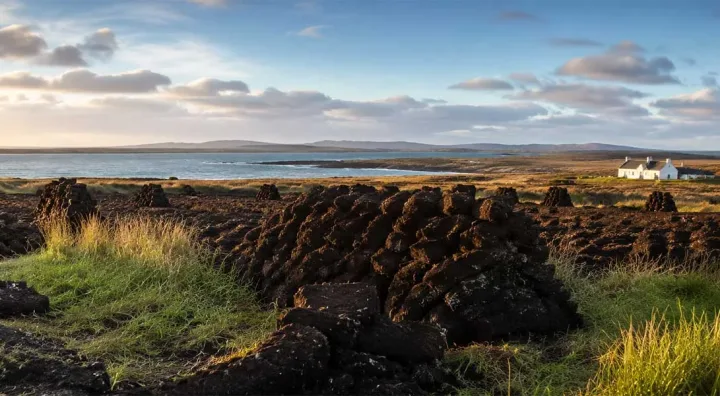
Some aromas can divide a tasting table in seconds. Peat is one of them. For some whisky lovers, that memory of smoke, fireplace, iodine, damp earth or dying embers is one of the great thrills of Scotch whisky. For others, it can be a difficult, almost challenging gateway. Even so, reducing peated whisky to the idea of “smoky whisky” barely scratches the surface.
Peat is not an added flavour or a decorative flourish. It is ancient organic matter, a traditional fuel and, above all, a production tool that can express itself in very different ways depending on how it is used. Its presence in the glass depends as much on the landscape it comes from as on the choices made during malting, fermentation, distillation and cask maturation.
What peat is and why it became linked to whisky
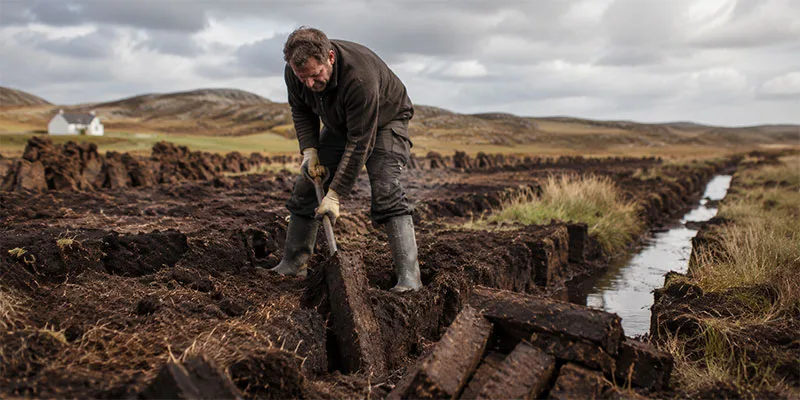
Peat forms in cold, wet areas where plant remains such as mosses, heather, grasses and roots decompose very slowly in waterlogged ground. Over centuries, this matter compacts into dark, dense layers rich in organic compounds. For generations, in regions where wood was scarce, it was cut into blocks, air-dried and used as domestic fuel.
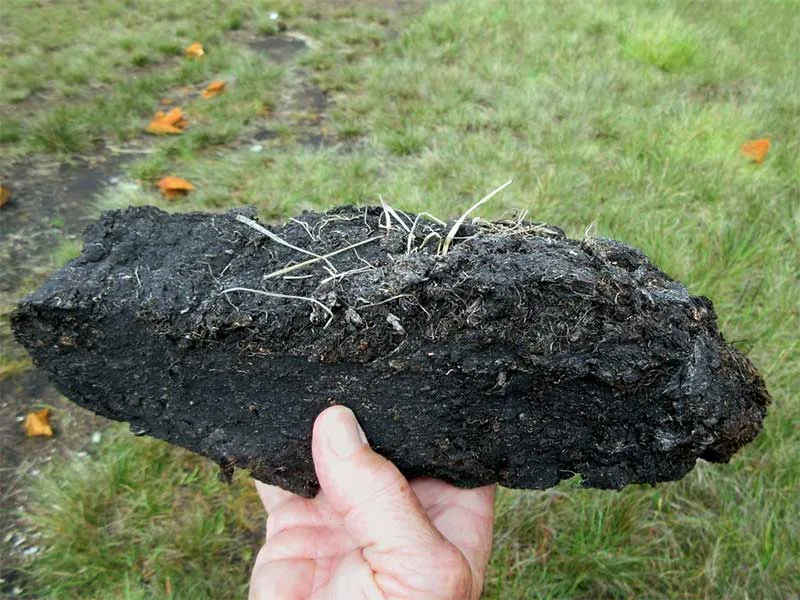
In whisky, its historical role is tied to one specific stage: drying malted barley. After germination, the grain must be dried to stop the process and preserve its fermentable sugars. Wherever peat was the available fuel, its smoke would permeate the still-damp barley. What began as a practical solution eventually became a defining stylistic trait.
Scotland is the territory most closely associated with peated whisky, especially islands and coastal areas such as Islay and Orkney, although peat bogs exist in other countries and traditions too. The key lies not only in using peat, but in what kind of peat is used, how it is burned and how long it remains in contact with the grain.
Not all smoke tastes the same
One of the most common misconceptions is that peat always delivers the same profile. In reality, the smoke may recall ash, dried seaweed, an old apothecary, leather, wet soil, cured meat, burnt wood or even sweet notes of glowing embers. The composition of the peat bog has a major influence: peat rich in heather and surface plant matter is not the same as peat formed at greater depth, with a different concentration of compounds produced by decomposition.
During combustion, aromatic molecules from the phenol family are generated. These include compounds associated with medicinal, smoky, tarry or spicy sensations. But in the glass they do not act in isolation. They combine with the character of the spirit, the aromas created during fermentation and the influence of the wood, producing very different profiles even among whiskies that, on paper, start from intensely peated malts.
The famous ppm: useful, but not the whole story
In the world of peated whisky, the abbreviation ppm, parts per million, appears frequently and is used to indicate the concentration of phenols in the malt. It is a useful guideline for classifying malts according to greater or lesser exposure to peat smoke. A lightly peated malt may sit at low levels; others, designed for more intense styles, reach far higher figures.
It is worth clarifying an important point: this value usually refers to the malted barley before the whisky is made, not necessarily to the final liquid that reaches the bottle. Losses and transformations occur throughout the process. Some phenolic compounds are left behind in the mash, others are modified during fermentation, and distillation selects which components pass into the heart of the spirit. Later, maturation softens, integrates or shifts the perception of smoke.
That is why a high ppm figure does not automatically guarantee a more aggressive mouthfeel. Two whiskies made with malts of similar intensity can taste very different if the stills, cut points, cask type or maturation time change.
The distillery also decides how much smoke makes it through
Peat enters the picture during malting, but its final role is shaped throughout the entire production chain. Extended smoke drying can load the barley with aromatic compounds, yet the producer then has many ways to modulate the result. Fermentation length, for example, can encourage fruitier or more robust profiles, helping to balance the phenolic character.
Distillation is another decisive stage. The shape of the still, the level of reflux and the moment at which heads, heart and tails are separated all influence texture and the amount of smoky notes that pass into the final spirit. A more selective cut can produce a finer, more restrained peated whisky; a different approach may preserve greater density, oiliness and aromatic power.
The cask adds another layer. First-fill wood, refill casks, American or European oak, vessels that have held fortified wines or other liquids: every choice shifts the balance. Vanilla, ripe fruit, spices, cocoa or nuts can embrace the smoke, make it rounder or, in some cases, heighten the sense of contrast.
How to approach a peated whisky
For beginners, peat can feel intimidating if approached through the most extreme examples. The best way is to move through styles, not assumptions. Some whiskies offer delicate, dry and elegant smoke; others are maritime, saline and medicinal; some show a more earthy peat character, while others weave embers together with fruit, grain or cask sweetness.
- Serve it without rushing: the right glass and a few minutes of air help the smoke make room for other aromas.
- Add a few drops of water: this can open up the whisky and soften the alcoholic sensation, though it is best done gradually.
- Try it with food: mature cheeses, smoked fish, grilled meats, dark chocolate or nuts can create interesting pairings.
- Compare styles: tasting an unpeated whisky alongside a lightly peated one makes it easier to understand what smoke contributes.
A mark of character, not a competition
Whisky culture has sometimes turned peat into a test of endurance: the more smoke, the more character. That view oversimplifies a far richer category. Peat should not be judged by intensity alone, but by integration, balance and its ability to converse with the spirit.
Great peated whiskies are not necessarily those that make the biggest impact on the first sip, but those in which smoke makes sense within the whole. It may act as a backbone, an aromatic accent or a dry counterpoint to cask sweetness. In every case, its appeal lies in a complex transformation: from a damp, vegetal landscape to a lingering aroma in the glass.
Understanding peat helps you drink better. It allows you to read whisky with greater nuance, move beyond myths and discover that behind the smoke lie geology, tradition, chemistry and craft. And, as with so many acquired pleasures, sometimes one well-chosen glass is enough for what once seemed difficult to become fascinating.