
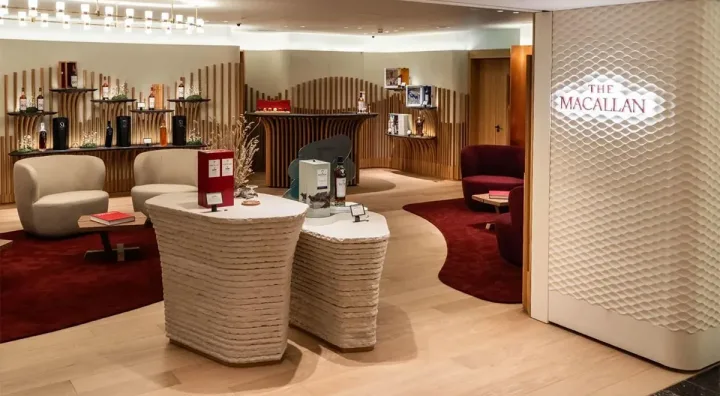
The Macallan has taken another step in its international strategy with the opening of a permanent boutique in Harrods, one of London’s great showcases of luxury. It is a significant move: it places the Speyside single malt in an environment where whisky is no longer seen only as a drink, but also as a cultural object, a collector’s piece and a brand experience.
The choice of Harrods is particularly meaningful. The celebrated London department store has long been associated with high-end consumption and international tourism, two territories where The Macallan moves with ease. For a house that has built much of its prestige on the selection of Sherry-seasoned casks, flawless presentation and a carefully crafted narrative around its Scottish origins, having its own space in this setting reinforces its position in the ultra-premium whisky category.
A showcase for Speyside single malt
The Macallan belongs to Speyside, one of Scotland’s most renowned regions for malt whisky production. Although Speyside is diverse, it is often associated with elegant, fruity and approachable profiles, along with a strong tradition of using casks that have previously held Sherry wines. In The Macallan’s case, that relationship with Sherry-seasoned oak is one of the core elements of its identity.
The new boutique is not simply a point of sale. Spaces of this kind are designed to convey the brand’s entire world: the architecture, materials, lighting, displayed artworks and the way each bottle is presented all form part of a carefully constructed story. In a market where high-end whisky consumers increasingly value origin, craftsmanship and exclusivity, the setting becomes an extension of the product itself.
The décor incorporates references that enthusiasts will immediately recognise: copper linked to the stills, nods to the Speyside landscape and allusions to the historic connection with Jerez. These elements help explain, without the need for a masterclass, why The Macallan has made cask influence one of its main points of distinction.
Harrods and The Macallan: an alliance rich in symbolism
Harrods is not a neutral location. For many spirits brands, a prominent presence in this store means reaching a global, well-travelled clientele willing to invest in distinctive products. In The Macallan’s case, the association also connects with an image of British prestige that the brand has cultivated over many years.
The boutique forms part of a broader trend: the great whisky houses no longer rely solely on traditional distribution. Increasingly, they are investing in their own spaces, guided experiences, personalisation services and launches tied to specific locations. The aim is to better control the narrative, build a closer relationship with consumers and offer something that cannot be replicated on a standard retail shelf.
This approach is especially relevant at a time when the global luxury whisky market is undergoing adjustments. After years of strong demand, some companies have acknowledged a more complex environment, with more selective consumers and growing pressure on higher-priced expressions. In response, The Macallan appears to be holding to a clear reading of the market: less volume, more added value and a stronger experiential dimension.
Rare Cask and the appeal of place-linked editions
The boutique opening was accompanied by a special edition of just 100 units of The Macallan Rare Cask 2026 linked to Harrods. Without entering into the purely speculative dynamics that often surround launches of this kind, it is interesting to consider the role they play within the strategy of a brand such as The Macallan.
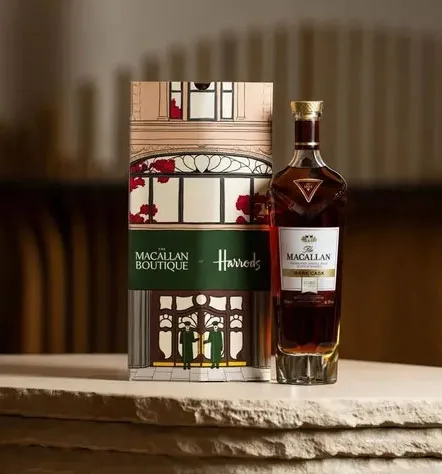
Rare Cask is a range that places the emphasis on the selection of sherry-seasoned casks and on an intense organoleptic profile, shaped by notes of dried fruit, spices, ripe fruit and fine oak. Its positioning works well for consumers looking for a single malt with a clearly recognisable character, but also for collectors who pay close attention to design, presentation cases, numbering or the story surrounding a particular bottle.
Editions linked to a specific place, such as a boutique or an airport, add another layer: the memory of travel. The whisky becomes a physical reminder of an experience, something with considerable weight in the luxury segment. For some buyers it will be a bottle to open; for others, a piece to preserve. Both interpretations are part of today’s market.
Luxury retail as an experience, not just a purchase
The Harrods boutique includes services commonly found in this kind of high-end space, such as the option to personalise bottles or take part in tastings. These are highly effective ways to bring the product closer to consumers without relying solely on technical sheets. In whisky, tasting, comparing and listening to a well-structured explanation can completely change the perception of a particular expression.
The gastronomic dimension is also significant. The integration of table experiences, pairings or private formats allows single malt to be placed in less rigid settings. The Macallan, with its cask-led profile and aromatic richness, can work with dark chocolate, dried fruits, mature cheeses, glazed meats or desserts with caramel and spices. Proposals of this kind help broaden consumption beyond the traditional after-dinner dram.
- For enthusiasts: it offers the chance to discover hard-to-find expressions and gain a deeper understanding of the house philosophy.
- For collectors: it strengthens the appeal of editions tied to a specific space.
- For the brand: it allows the experience to be controlled from beginning to end, from the narrative to the service.
What this move reveals about whisky today
The opening of a The Macallan boutique in Harrods confirms a clear evolution in high-end Scotch whisky. The bottle remains at the centre, but it is no longer enough on its own. Context, staging, the origin of the wood, graphic design, artistic collaboration and the feeling of access to something uncommon all matter.
This model is not without debate. Some enthusiasts are wary of whisky’s growing orientation towards luxury, believing it distances certain brands from their more purely sensory dimension. Others, however, see these spaces as an opportunity to elevate the culture of the spirit and present single malt with the same care afforded to wine, fine dining or watchmaking.
In any case, The Macallan once again shows that it understands the symbolic value of places. Harrods is not just a store: it is a stage. And on that stage, Speyside whisky is presented as heritage, experience and an object of desire for an international audience seeking more than a recognisable label.
More information on The Macallan website