
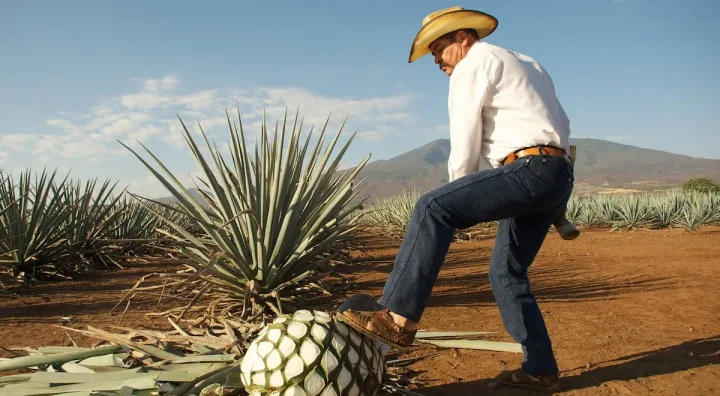
Very interesting to investigate the differences between mezcal and tequila, two representative distillates of Mexican culture.
As many have asked what the differences are between tequila and mezcal, in this post we will talk about the characteristics of these two spirits from Mexico City. It is important to note that there are many varieties of both, however, the main difference is that tequila can only be created from blue agave tequilana weber, while mezcal can be made from up to 20 types of maguey, In addition, assemblages of more than one type of agave can be created.
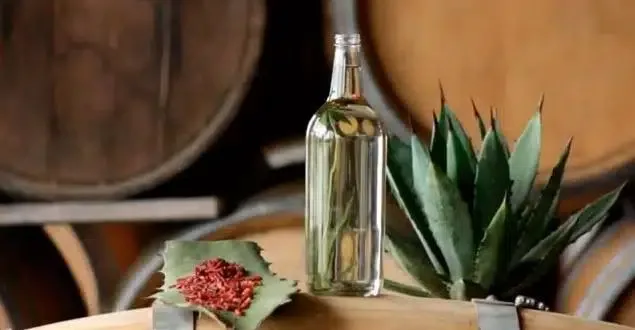 The main difference between mezcal and tequila is that the latter can only be created from tequilana weber blue agave,
According to the General Declaration of protection of the Tequila Designation of Origin and the NOM of Tequila, the aforementioned variety of agave must meet other requirements so that it can be used in the manufacture of Tequila:
- Its cultivation must be carried out within a geographical area delimited by the general declaration of designation of origin.
- It must be registered with the Tequila certification body.
The average time required by the plant blue agave tequilana weber It takes 7 years to reach maturity, at the end of which, the maximum accumulation of carbohydrates in this plant is reached. The main carbohydrate is inulin, a high molecular weight polymer formed by approximately 43 fructose monomers whose ends are constituted by a glucose molecule.
Mezcal and tequila production process
Another aspect in which mezcal and tequila differ is that the former still maintains an artisanal process. That means that once the agaves are jimado, their hearts are cut out, they are placed in an oven dug underground. In it, the pineapples are placed on stones or lit logs, a mound is made in which the pineapples are cooked.
Although officially mezcal can be produced industrially, the fermentation method does not require chemical yeasts, is done in conical stone oven, its grinding is in a bakery or with a ripper, It is fermented with natural yeast and then distilled in a copper still, this results in its production being reduced.
What is jimar?Harvest the agave, removing the outer leaves with a coa, for the preparation of mezcal.
From the Nahuatl xima, to shave. Cut the maguey stalks to be able to roast the pineapples and make mezcal or tequila. This process is carried out when the plant has developed sufficiently and reaches its ideal size. Depending on the type of maguey or agave, the times vary for the maturation of the leaves and, therefore, for cutting them.
On the contrary, in tequila, the production process takes place in masonry ovens. These are also closed spaces, but the heat source is through steam. And it is through this that the pineapples are cooked. In both cases the piñas have to be cooked in order to extract the agave juice with the type of sugar that will later be fermented and distilled.
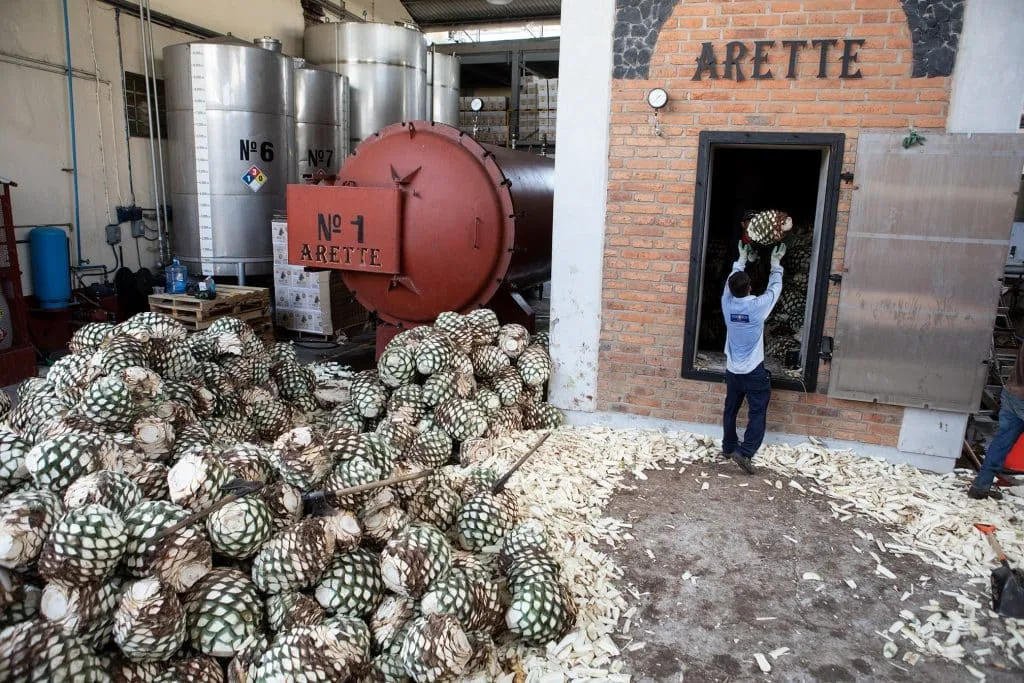 The industrial process, In this case, it is done in a more automated way, using very large steam ovens, crushers, chemical yeast fermentation to create the spirit at massive levels.
While the tequila is made in a steam oven and the mezcal is cooked in ovens with wood, hence its distinctiveness can be seen in the final product. intense smoky flavor and the cooked agave notes are much more noticeable. Furthermore, mezcal changes a lot depending on the maguey used. Tequila is usually a little sweeter and floral, but the agave flavor is not perceived as much.
The DO (denomination of origin) also varies between both distillates.
Tequila can only be produced in some municipalities in five states (Jalisco, Nayarit, Michoacán, Tamaulipas and Guanajuato). On the other hand, the DOM (denomination of origin of mezcal) is broader, covering some municipalities of Oaxaca, Guerrero, Michoacán, Tamaulipas, Durango, Guanajuato, San Luis Potosí, Zacatecas, Puebla, State of Mexico, Morelos and Aguascalientes—these last three were recently incorporated and have caused some controversy.
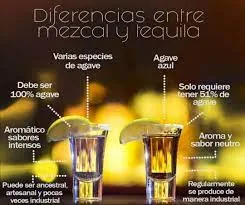
The following image summarizes some of the differences between mezcal and tequila:
Tequila and mezcal classifications
There is young or white mezcal, which is bottled immediately after being distilled; reposado, which matures between 2 and 12 months in wooden containers, and anejo, if it rests for more than 12. This classification is based on that of tequila.
Depending on its maturation, mezcal can be matured in glass for months in containers of more than 5 liters and less than 20; It can be mezcal abocado, which is flavored with maguey worm, herbs or fruits; or distilled mezcal with brisket, fruit or corn husks. The latter, only white, is distilled 3 times.
It can also be classified as mezcal, artisanal mezcal or ancestral mezcal, depending on the conditions and infrastructure used in the cooking of the pineapples or hearts, their grinding, fermentation and distillation.
For its part, tequila, according to the characteristics acquired in processes after distillation, is classified into:
- White.
- Young or Gold.
- Restful.
- Old.
- Extra Aged.
white tequila.- Product whose commercial alcoholic content must, where appropriate, be adjusted with dilution water.
Young or gold tequila.- Product susceptible to being targeted. Its commercial alcoholic content must, where appropriate, be adjusted with dilution water. The result of blending white Tequila with reposado and/or aged and/or extra aged Tequilas is considered young or gold Tequila.
Abocado is understood as the procedure to soften the flavor of Tequila, by adding one or more of the following ingredients: Caramel color, natural oak or oak extract, glycerin and sugar-based syrup.
reposado tequila.- Product capable of being poured, subject to a maturation process of at least two months in oak or oak wood containers. Its commercial alcoholic content must, where appropriate, be adjusted with dilution water.
Tequila Maturation is understood as the slow transformation of the product that allows it to acquire additional sensory characteristics, obtained by physicochemical processes that naturally take place during its stay in oak or oak wood containers.
Reposado Tequila must mature in oak or oak wood containers for at least two months.
The result of mixing reposado Tequila with aged or extra aged Tequilas is considered reposado Tequila.
aged tequila.- Product capable of being poured, subject to a maturation process of at least one year in oak or oak wood containers, whose maximum capacity is 600 liters, its commercial alcoholic content must, where appropriate, be adjusted with dilution water. The result of mixing aged Tequila with extra aged Tequila is considered aged Tequila.
For aged Tequila, the maturation process must last at least one year in oak or oak wood containers, with a maximum capacity of 600 liters.
The result of mixing aged Tequila with extra aged Tequila is considered aged Tequila.
extra aged tequila Product capable of being poured, subject to a maturation process of at least three years, without specifying the maturation time on the label, in direct contact with the wood of oak or oak containers, whose maximum capacity is 600 liters, its commercial alcoholic content must, where appropriate, be adjusted with dilution water.
If you want to continue investigating the topic, I leave you here this video: