
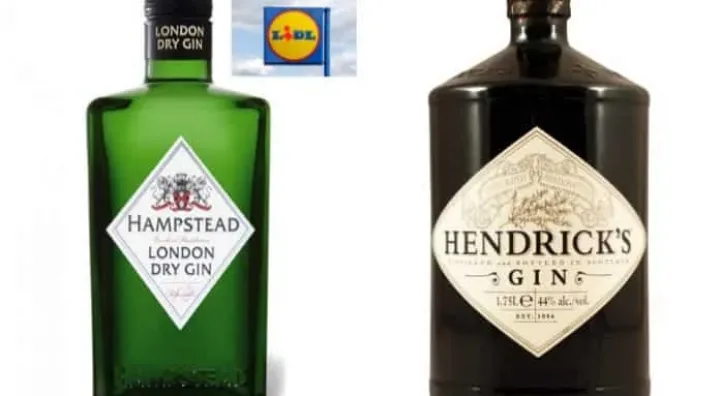
The Edinburgh court ordered Lidl to stop selling its Hampstead gin in its Great Britain supermarkets
“The similarity between the two gins is not accidental”, said the Edinburgh judge after Lidl changed the label and bottle. For the moment, the court’s decision has been firm: it ordered Lidl to stop selling its Hampstead gin in its supermarkets in Great Britain. This happened as a result of a lawsuit filed by the producers of Hendrick’s gin.
They believe that the distilled bottle of Hampstead gin, placed on shelves by the German discount giant last December after a restyling operation, “looks” too much like their product.
“The similarity between the two gins is not accidental”, said the Edinburgh judge after Lidl changed the label and bottle.
According to the lawyers for William Grant and Sons, “the new ‘diamond’ label of Hampstead gin, which has been on sale in Great Britain for a decade, reproduces in excessive detail what has characterised the ‘apothecary’ bottle of Hendrick’s gin since January 2012, and even the shape of the bottle and the colour of the glass were modified by the German company specifically to resemble the famous gin produced in the Ayrshire region”.
Its launch and design change
Hampstead gin had been sold in Lidl stores for at least 10 years, but the bottle was redesigned at the end of 2020 and began appearing on shelves in December: “Lidl stopped selling its own-brand gin in a row of imitation bottles with Hendrick’s. Lidl says there are ‘clear and obvious differences’ between Hendrick’s registered trademark and its own Hampstead gin”.
Lidl was forced to temporarily stop selling a version of one of its own-label gins after being sued by the makers of Hendrick’s Gin, who claim that a registered trademark had been infringed.
The new look of Hampstead gin also included a colour tone that came very close to Hendrick’s “pale” shade for the new label. William Grant and Sons’ lawyers argued that “even the cucumber slices shown graphically on the label of Lidl’s new bottle alluded to the fact that Hendrick’s gin is, almost uniquely among gins, suited to being served with cucumber slices as a garnish”.
“The delicate bouquet of the Scottish gin does in fact recall the rose petals and cucumber used in distillation to ensure its particular aromatic character, and a slice of the cucurbit in the glass is the magic touch that enhances its flavour”, they argued as further proof for their claim that Lidl’s bottle was too “similar” to the bottle of Hendrick’s gin.
 The new look of Hampstead gin also included a colour tone very close to Hendrick’s “pale” shade for the new label.
The lawyers for the Scottish distillery also gave the judge numerous examples of comments circulating on social media highlighting the visual similarities between the two bottles.
Judge Lord Clark also noted the curious fact that Hampstead gin cost £9.99 per bottle before the redesign and, after the “beauty treatment”, reached the shelves at £15.99. A good price for a branded gin.
In the judgment, the Scottish judge wrote: “Whether or not there was a deliberate intention to deceive, there is sufficient basis to show that there was an intention to take advantage. It is difficult to regard the redesign, including the change in bottle colour, as accidental or random”. Lidl’s immediate reaction through a spokesperson was: “Although disappointed, we take note of the court’s decision and have implemented the ruling”.
 Hampstead gin had been sold in Lidl stores for at least 10 years, but the bottle was redesigned at the end of 2020 and began appearing on shelves in December.
Notes:
- Hendrick’s Gin is produced by the Scottish firm William Grant and Sons and was launched in 2000, with bottles carrying a diamond-shaped label in a trademark that came into force from January 2012.
- Lidl is the parent company and owner in the United Kingdom of the “Hampstead” trademark in the same class 33 for alcoholic beverages, filed on 8 March 2012 and registered on 12 March 2013.