
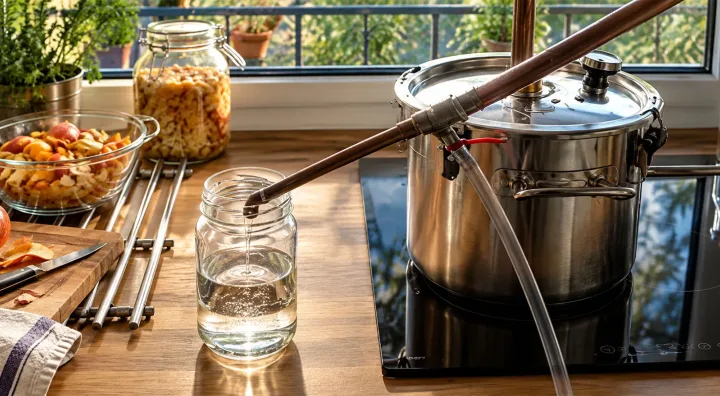
Asclepius Merlai introduces us, through his Manual de destilación urbana, to the basic concepts of home alcohol distillation
Home alcohol making and distillation has become a topic of growing interest today, a rewarding kind of hobby for those who enjoy tasting high-quality spirits.
Asclepius Merlai explains, through his work Manual de destilación urbana, how his life as a distiller began and touches on a number of specific aspects of the subject.
(Note: The Manual de destilación urbana is linked solely for informational and documentary purposes. The production and distillation of alcohol is subject to the legislation in force in each country. In Spain, artisanal distillation requires compliance with specific administrative, tax and technical requirements)
In his view, the quality of most distillations carried out by enthusiasts using homemade stills far surpasses that of all the aguardientes, rums, vodkas or gins—and indeed spirits in general—that can be found in supermarkets for under €25-30. 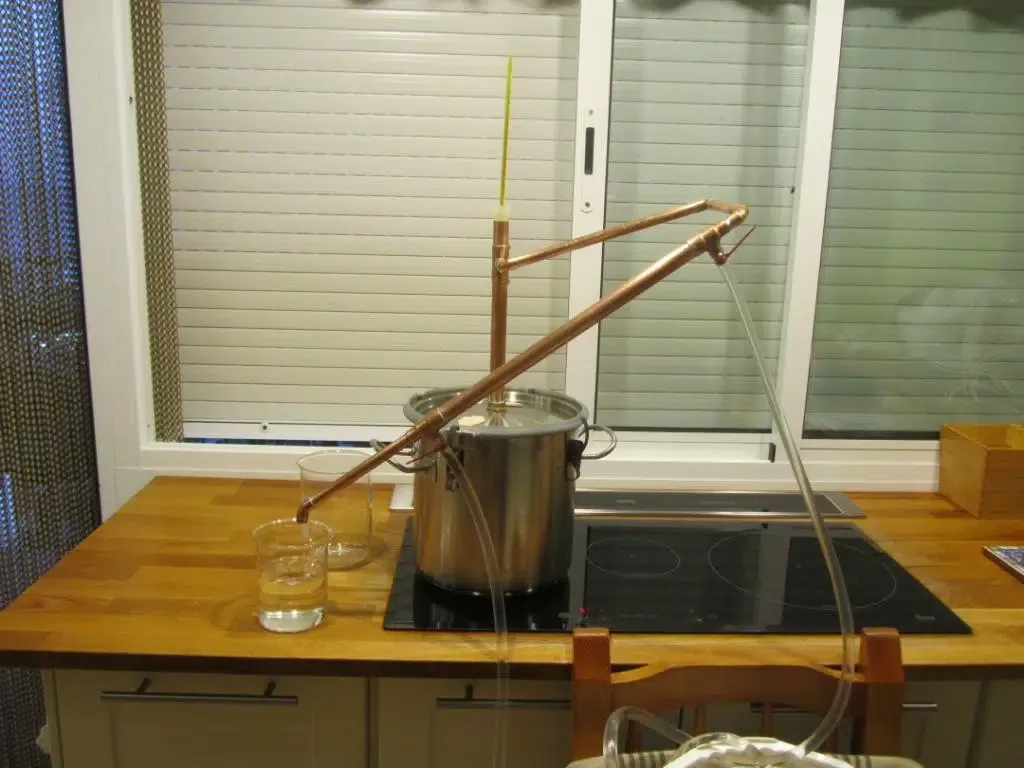 Home alcohol making and distillation has become a topic of growing interest today, a rewarding kind of hobby for those who enjoy tasting high-quality spirits.
As we move through his work, we come to understand the answers he dares to call “simple” about how mass-produced alcohol affects the matter, since it is not agricultural in origin but industrial—and, in terms of quality, it cannot compete with the natural aromas of homemade spirits, whether produced in an urban or rural setting.
When did your interest in making aguardientes begin?
It started when I was a child. During the long summer school holidays, my parents did not know what to do with me, and my mother would send me to the village, to my grandfather’s house.
He was a tall, strong, serious man with few close friends. He had been in the war, where he had lost a leg. Unable to keep working on the farm, one day, according to my mother, he killed all the animals in the yard and set up an illegal distillery right there.
He began striking deals with villagers who had fruit trees, mainly apple and pear trees. The business was very simple: people brought the fruit to my grandfather; he made a must, fermented it and, finally, distilled it.
From the aguardiente he obtained, my grandfather kept a portion, which he later resold in the county town.
I helped my grandfather as much as I could and stayed by his side throughout every summer holiday. By the age of 12, I was already driving a small tractor with a trailer loaded with pears, apples and plums.
Now, 30 years later, I am a worker like everyone else. I live in a flat that is too small, in a city that is too noisy, and I pay instalments that are too high.
Even so, although my grandfather and that farm no longer exist, I have kept that craft alive. Only as a personal hobby, of course, and with no intention of making a profit.
The Manual de destilación urbana* is already considered a classic for those who want to take their first serious steps into the world of home alcohol distillation. What clarification would you offer to those who consult it?
- The content of this manual is not intended to encourage anyone to commit any illegal act or anything prohibited by the competent authorities.
If home alcohol distillation for strictly personal use is forbidden in your country, community, region or town, do not distil.
There are many countries where home distillation of aguardientes for personal use is permitted. This book was written especially for the community of urban and home distillers in those countries.
For everyone else, the content of this manual is purely informational.
Likewise, this guide is not intended to lay down the law, nor does it claim to surpass other well-known distillation methods whose effectiveness has been more than proven.
What are the working steps involved in home alcohol distillation?
- The process consists of several stages:
- Preparing the wash.
- Fermenting the wash.
- Distilling the fermented wash.
- Flavouring and subsequent treatment.
The first step is to choose the raw materials, as these are what will give our spirit its particular character.
Next, we use them to prepare a sugary solution — which, from this point on, we will call the wash — and create the right conditions for it to ferment with the help of the appropriate yeast.
Once fermentation has finished, we wait for a set period of time, which may range from a couple of days to a couple of weeks. During this period, the dead yeast present in the wash gradually settles at the bottom of the fermentation vessel.
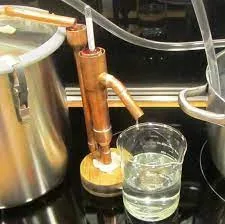
We then move on to distillation and, finally, flavour the spirit, either by using essences or through ageing techniques.
Each of these steps is simple and enjoyable, and involves neither great mysteries nor major dangers. As far back as the Middle Ages, spirits were being made from wines and other fermented juices, without people fearing they would go blind or die from poisoning.
The main danger of alcohol comes from chronic abuse, irresponsible behaviour while under its effects, or adulteration caused by ignorance or by the pursuit of profit.
Urban distillation is as safe as keeping pigeons.
Why do you consider spirits obtained through home distillation to be superior to commercial products?
- A friend of mine used to say that every success or failure begins with a few magic words.
During a dinner, one of the guests was praising a good-brand spirit he had bought in a specialist shop. I explained that I had grown up with my grandfather in a clandestine distillery and told him that, in my opinion, agricultural, homemade and traditionally made spirits were far superior to commercial products.
My companion flew into a rage and gave me a thousand and one reasons which, in his view, completely invalidated what I was saying: that you could go blind, that in some place or other who knows how many people had died from drinking illegal alcohol, that did I really expect him to believe that…
None of the arguments I put forward seemed to make him see reason. If someone has died or gone blind from drinking adulterated alcohol, the problem is not that the alcohol was homemade, but that it had been adulterated with methanol or other toxic substances.
We are talking about products tampered with by people acting for profit, who dilute or mix alcohol with other substances to increase their margins.
For example, the white whiskey distillers of the Appalachians, who have become widely known thanks to globalisation and channels such as Discovery, did not kill or blind anyone simply because they were making alcohol illegally in the woods of their region.
That argument looked as though it might end badly, as the spirit had gone to my companion’s head.
So I told him that what he was drinking was nothing more than industrial alcohol, made through chemical processes and dressed up with a little perfume.
How did the matter end?
- I told him that what he thought he was drinking was nothing but an illusion created by marketing and that, without a doubt, I could do better.
Then he challenged me and uttered the magic words: “You haven’t got the b…”
Without a moment’s hesitation, I set the terms of the challenge, and that is how I came back to making spirits. I undertook to create a spirit in my flat using only products bought in supermarkets and hardware stores.
A year later, we would meet again to hold a tasting in front of trusted witnesses. I would have him try three spirits: two shop-bought ones and the one I had made myself.
Then he would have to say which of the three he liked best—or, if he preferred, guess which one I had made, supposedly because of its poor quality.
My opponent accepted.
The next day, a full-blown ordeal began, with trips back and forth everywhere: hardware stores, drugstores, supermarkets, agricultural supply shops and Chinese bazaars.
The number of kilometres I covered to make 0.7 litres of “homemade” spirit exponentially surpassed those travelled by the Greek soldier Pheidippides in his entire lifetime.
It may be bad form to say it myself, but I won the bet by a landslide.