
In the world of spirits, one convenient oversimplification comes up again and again: traditional copper pot stills produce drinks with more body and character, while distillation columns are used to make neutral alcohol. You hear it at tastings, on distillery tours and in conversations among enthusiasts. There is some historical truth to it, but as a technical explanation it falls short.
The flavour of a whisky, rum, brandy, tequila or vodka does not depend solely on whether the vapour has passed through a batch still or a column. The raw material, fermentation, equipment design, heating intensity, distillation strength, contact with copper, the cuts made by the master distiller and, of course, any subsequent ageing all play a part. The still matters, but it does not work in isolation.
The traditional pot still: more than a romantic image
The copper still, often known in English as a pot still, works in batches. The boiler is filled with a fermented liquid or with a first distillation, heated, the distillate is collected and, once the run is complete, the still is emptied so the process can begin again. This system is closely associated with Scotch and Irish malt whisky, Cognac, certain heavy-style rums and many traditional European eaux-de-vie and brandies.
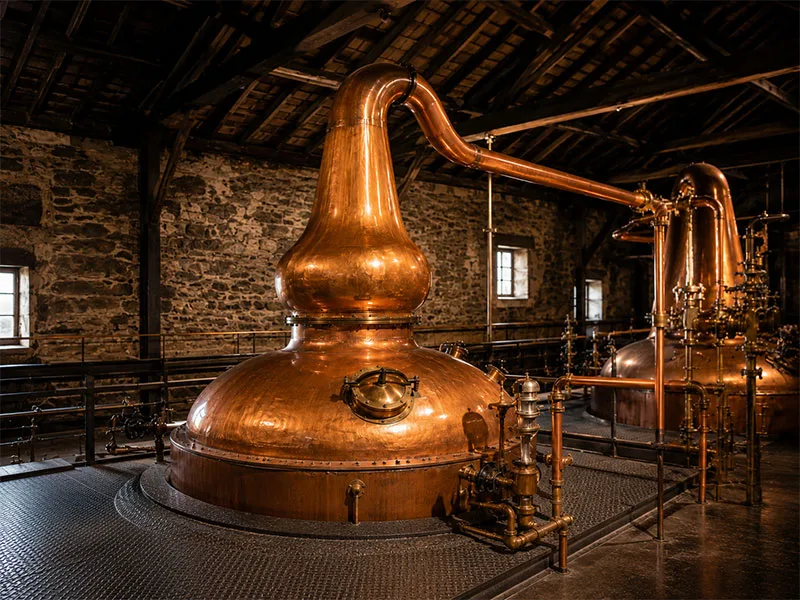
Its reputation for producing aromatic spirits comes from the fact that, in general, it allows a significant share of fermentation-derived compounds to remain: esters, higher alcohols and other elements that contribute fruity, floral, oily, spicy or herbal aromas. Even so, not every copper pot still produces dense or robust spirits. The shape of the boiler, the height of the neck, the angle of the lyne arm, the size of the condenser and the pace of distillation can all noticeably alter the final profile.
A tall still with plenty of natural reflux can produce a lighter, more refined distillate. A shorter one, with less internal rectification, will tend to let more heavier components pass through. Even within the same category, two distilleries using apparently similar stills can achieve very different styles.
A distillation column is not the same as neutrality
The distillation column, also known as a continuous still, allows volatile components to be separated with greater precision. Instead of working in batches, it can be fed continuously. Inside, plates or rectifying elements encourage successive cycles of evaporation and condensation. This architecture makes it possible to reach very high strengths when an extremely pure alcohol is required, as in the production of vodka or neutral bases for liqueurs and gins.
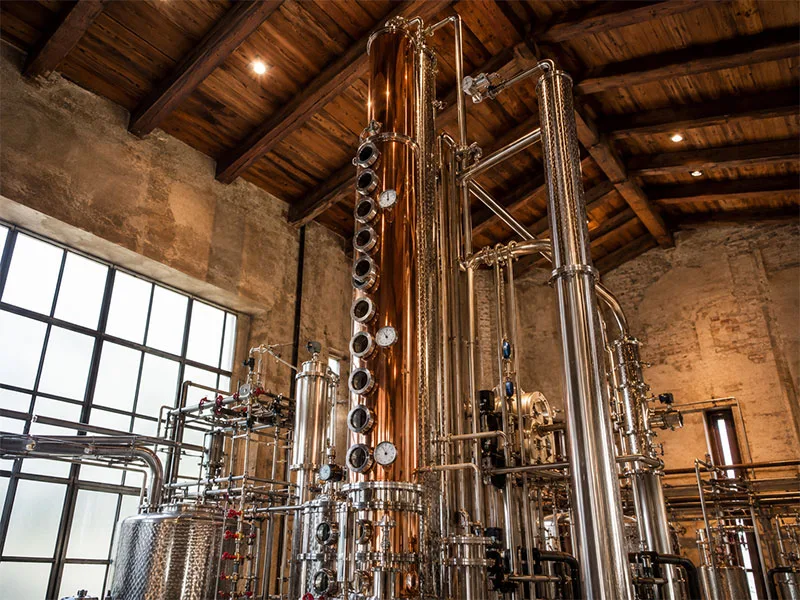
However, the fact that a column can produce neutral alcohol does not mean it is destined to do so. Its main advantage is control. Depending on the number of plates, the draw-off point, the amount of reflux and the way it is operated, a column can produce light, medium-bodied or highly expressive spirits. It is not only an industrial tool; it is also an instrument of precision.
Classic examples prove the cliché wrong. Many agricole rums from the French Caribbean are made in columns designed to preserve the vegetal character of sugarcane. A large share of American bourbon and rye whiskey starts life in columns before, in some cases, passing through a second piece of rectifying or refining equipment. Armagnac, one of France’s great brandies, has traditionally been linked to distinctive column stills designed to retain character rather than erase the raw material.
Reflux, cuts and strength: the distiller’s true language
To understand why a spirit tastes the way it does, it helps to look beyond the type of still being used. Several technical factors have a decisive influence on the final result:
- Reflux: when vapour partially condenses and evaporates again within the system, the spirit becomes more refined. Higher reflux generally means greater aromatic purity and fewer heavy compounds.
- Distillation strength: distilling at a lower strength tends to preserve more of the character from fermentation and the raw material. A higher strength allows for more precise separation and produces cleaner profiles.
- Cuts: separating heads, hearts and tails is a fundamental decision. This is where the distiller defines which fractions make it into the final spirit and which are discarded or redistilled.
- Speed and heat: slow distillation can encourage more controlled separation, while more intense heating may carry over less volatile compounds.
- Still design: height, shape, copper surface area, condensation and take-off points can matter just as much as the general category of the equipment.
These elements explain why two column-distilled rums can be radically different from one another, or why a pot still whisky may seem more delicate than another column-distilled spirit. Distillation is not a fixed recipe, but a chain of connected decisions.
Raw material and fermentation matter too
Before the liquid ever reaches the still, a major part of its identity has already been shaped. In whisky, the grain, malting, yeast strain and fermentation time are all decisive. In rum, starting from molasses is not the same as starting from fresh cane juice. In brandy, the grape variety and the acidity of the base wine influence distillation. In tequila or mezcal, the type of agave, cooking method and fermentation can create profound differences.
Distillation concentrates, selects and organises these elements, but it rarely creates flavour out of nothing. That is why a neutral spirit requires not only a column capable of reaching high purity, but also a strategy aimed at removing most of the traits of origin. When the goal is to preserve identity, the distiller adjusts the equipment in the opposite direction.
Why this distinction matters to consumers
For enthusiasts, understanding these differences makes it easier to read a label and interpret a tasting. A reference to a copper pot still may be relevant, but it should not automatically be taken as a guarantee of complexity. Likewise, the word “column” should not be understood as a synonym for a simple product with no character.
In categories such as rum, where highly diverse styles coexist, this nuance is especially useful. There are elegant, aromatic column-distilled rums, intense and heavy pot still rums, and blends that combine both profiles in search of balance. In whisky, the combination of distillation, cask and maturation time ultimately shapes the result. In brandies and eaux-de-vie, local tradition is often just as important as the technology used.
The question, then, should not only be whether a spirit comes from a pot still or a column still. What really matters is how that equipment has been used and with what intention. Technique provides the tools; style is defined by the distiller. And that, more than the metal or the shape of the apparatus, is where much of the personality that finally reaches the glass resides.