
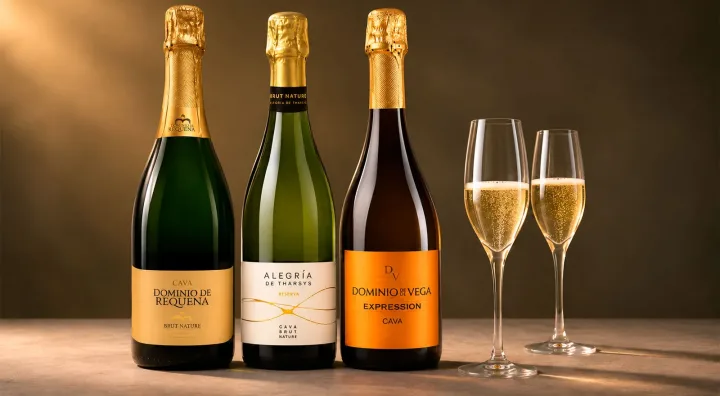
Valencian cava is DO Cava made in Requena (Valencia), one of the four zones within the DO Cava and the only municipality in the region of Valencia included in the denomination. Its vineyards sit at elevations of 600 to 900 metres and mainly grow macabeo and chardonnay. Producers include Pago de Tharsys, Dominio de la Vega, Hispano+Suizas, Torre Oria and Chozas Carrascal.
It is one of cava’s best-kept secrets, despite being made for more than four decades. Here’s what sets it apart, which wineries produce it, and which bottles from our Valencian cava range you could serve this Christmas.
- Denomination: DO Cava, Requena zone
- Where: municipality of Requena (Valencia)
- Vineyard elevation: 600–900 m
- Main grapes: macabeo and chardonnay (white); garnacha and pinot noir (red)
- Method: traditional method, with a second fermentation in the bottle
- Production: nearly 15 million bottles in 2024, according to local media
What is Valencian cava?
“Valencian cava” is not a denomination in its own right, but the popular name for cava made in Requena. It is every bit as much cava as that from Sant Sadurní d'Anoia: it follows the same DO Cava rules, uses the same traditional method and adheres to the same categories and minimum ageing requirements.
Under the DO’s zoning system, cava is divided into four zones: Comtats de Barcelona, Valle del Ebro, Viñedos de Almendralejo and Requena. Requena has no subzones, and its official name is simply “Requena”. If you come across “Zona de Levante”, that was a provisional name used before the final one was established.
If you’d like to know how it differs from Champagne, we explain it in Cava or Champagne: the real differences and which to choose.
Why is cava only made in Requena?
Requena is the only municipality in the Valencian Community included in the DO Cava. According to specialist media, it has been allowed to produce cava since 1982, when a Supreme Court ruling included its entire municipal area.
The Requena zone itself is more recent. It was recognised by a resolution published in Spain’s Official State Gazette on 2 February 2024, with effect from June 2021, following a lengthy legal battle by local producers. And in 2026, Requena is Spain’s City of Wine, bringing Valencian cava more attention than ever.
The terroir: elevation, climate and grapes
The defining feature of cava from Requena is its altitude. The vineyards lie between 600 and 900 metres, in a dry inland Mediterranean climate with cold winters, hot summers and a wide temperature range between day and night. This helps the grapes retain the acidity a sparkling wine needs.
The most widely planted varieties are macabeo and chardonnay among the white grapes, and garnacha and pinot noir among the red, which are used mainly for rosé. In the Penedès, cava also relies on xarel·lo and parellada. In Requena, macabeo and chardonnay take the lead, giving the wines a distinctive profile.
Cava wineries in Requena
The Requena Cava Producers’ Association, founded in 2013, brings together seven wineries: Pago de Tharsys, Dominio de la Vega, Hispano+Suizas, Torre Oria, Chozas Carrascal, Coviñas and Cavas Marevia. Outside the association, Vegalfaro also makes DO Cava, including an organic Brut Nature Gran Reserva.
Of these wineries, Licorea stocks cavas from two. From Pago de Tharsys, there is Dominio de Requena (Brut and Brut Nature) and Alegría de Tharsys. From Dominio de la Vega, there is Expression Brut and Brut Reserva Especial. Torre Oria also makes Aviva, which is not a cava, as we explain below.
Valencian cavas for Christmas
Here are the Requena cavas we currently have in stock. Approximate prices as of 17 November 2026.
- Dominio de Requena Brut — Brut · around €6.50
Our customers’ most popular Valencian cava. Ideal for buying by the case. - Dominio de Requena Brut Nature — Brut nature · around €7.95
The no-added-sugar version, perfect as an aperitif. - Dominio de la Vega Expression Brut — Brut · around €9.85
A great way to discover Dominio de la Vega without spending much. - Sofía Cañizares Brut — Brut · around €10.15
Another Requena brut option for around €10. - Carlota Suria Brut Nature — Brut nature · around €12.00
A Requena brut nature for around €12. - Alegría de Tharsys Brut Nature 2022 — Brut nature, vintage · around €12.15
Pago de Tharsys at its driest. - Dominio de la Vega Brut Reserva Especial — Brut, reserva · around €20.95
The most serious choice in this selection, ideal for dinner.
If you’re looking for Pago de Tharsys Medusa Brut Nature, it’s currently out of stock. The closest alternative is Alegría de Tharsys Brut Nature, from the same winery and in the same dry style.
Brut or brut nature? Brut nature contains less than 3 g/l of sugar, while brut contains less than 12 g/l. Choose brut nature with aperitifs and seafood; brut is a good match for the whole dinner.
Award-winning cavas from Requena
At Christmas, one of the most popular searches for cava from Requena is “award-winning cava”. A specific example is Dominio de Requena Brut, made by Pago de Tharsys, which won a gold medal at the 2019 Concours Mondial de Bruxelles, one of the world’s largest international wine competitions.
An award applies to a specific vintage or batch. If the medal matters to you, check that it appears on the label of the bottle you buy.