
Champagne Louis Roederer has once again placed Cristal 2008 in the international spotlight with the market release of this legendary vintage, unveiled in Reims during the celebrations marking the maison’s 250th anniversary. This is not simply the return of a celebrated vintage, but a different reading of the same wine: longer time in contact with its lees, a calmer evolution and a clear intention to reveal another stage of its maturity.
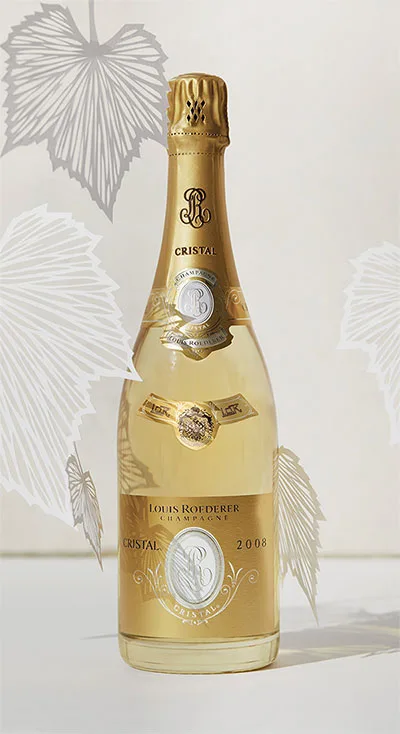
For decades, Cristal has held a singular place in the imagination of Champagne lovers. Originally created as a bespoke wine for the Russian imperial court, it went on to become one of the region’s most recognisable labels. Yet beyond its historic aura, its current appeal lies in the way Louis Roederer has refined an identity built on precision, chalk-driven energy and an unusual combination of delicacy and depth.
The importance of a cool, luminous vintage
The 2008 harvest is regarded as one of Champagne’s great recent vintages. It was a year of slow ripening, shaped by restrained temperatures and a drier, sunnier final phase that made it possible to achieve a particularly valuable balance: ripe fruit without any loss of freshness, firm acidity and a structure suited to long bottle ageing.
That profile fits especially well with the Cristal style. The cuvée seeks tension, aromatic purity and a texture that does not rely on exuberance, but on the wine’s architecture. In a region where climate decisively shapes the character of each harvest, 2008 provided the raw material for champagnes of remarkable longevity, with that sense of verticality that enthusiasts associate with the finest chalk soils.
The first release of Cristal 2008 was already received as one of the house’s most precise interpretations. This new presentation makes it possible to see how the vintage evolves when the wine spends more time in the cellars before reaching the consumer.
What a late release brings to Champagne
In great champagnes, the release schedule is almost as important as the harvest itself. A young wine may show drive, purity and potential; a version with extended ageing on lees tends to gain breadth, texture and nuances of fine bakery, nuts, umami or saline notes. It is not only a matter of age, but of managing time.
Prolonged contact with the lees, formed by the yeasts after the second fermentation in bottle, encourages a more complex evolution. In Champagne, this process is central to the aromatic depth and creamy sensation of many high-end wines. In the case of Cristal 2008, Louis Roederer specifically highlights this pursuit of greater texture and more immediate pleasure, without giving up the freshness that defines the vintage.
The maison has also emphasised the role of cellar work during ageing, including the movement of the bottles to encourage interaction with the lees. These kinds of technical choices, discreet but meaningful, can influence the wine’s final impression, adding volume and a more gastronomic dimension.
Cristal, between elegance and structure
Cristal’s identity has traditionally rested on the blend of Chardonnay and Pinot Noir from the house’s selected vineyards. For years, Louis Roederer has championed viticulture strongly focused on origin, with particular attention to phenolic ripeness, soil expression and the natural balance of the grape. That philosophy explains why some vintages seem to suit the cuvée’s profile better than others.
In 2008, the combination of acidity, ripeness and structure made it possible to craft a champagne of great tension, yet with enough substance to evolve for years. The late-release version is presented as a more accessible stage in terms of enjoyment: less dominated by future promise and more oriented towards present harmony.
For enthusiasts, the difference between a first release and a late release should not be read as a simple hierarchy. They are different moments in the life of the same wine. The first may feel more electric and austere; the second, more integrated, with a softer, more seamless mousse and a broader aromatic range. Both perspectives help reveal champagne’s ability to evolve without losing its identity.
Blanc and rosé: two expressions of the same vintage
The new release includes both the white and rosé versions of Cristal 2008. While they share the same origin and philosophy, each offers a different angle. The blanc tends to highlight precision, minerality and citrus tension, while the rosé adds a dimension of red fruit, gentle spice and a structure that can make it especially versatile at the table.
Prestige rosé champagne has gained increasing attention in recent years among collectors and sommeliers, not only because of its relative scarcity, but also for its ability to pair with more intensely flavoured dishes. In the case of Cristal Rosé, the winemaking seeks to integrate colour, texture and depth without drifting into a heavy profile, something particularly relevant in a vintage defined by marked freshness.
Serving and food pairings
A champagne of this calibre deserves careful service. It is best to avoid serving it too cold, as low temperatures can mute the aromas and tighten the texture. A generous white wine glass or a champagne tulip will show its evolution in the glass far better than a narrow flute.
At the table, a late-release Cristal 2008 can work beautifully with dishes where richness, salinity and precision come together:
- Shellfish, oysters and crustaceans prepared simply.
- Fine fish with light sauces, butter or marine-based reductions.
- Roast poultry, especially where there are toasted notes or reduced cooking juices.
- Mild soft cheeses and moderately matured selections.
- For the rosé, dishes with duck, bluefin tuna, mushrooms or subtly spiced cuisine of restrained intensity.
Beyond the luxury associated with the label, this new release of Cristal 2008 is compelling because it opens a conversation about something essential in Champagne: time. The same vintage can be vibrant in its youth, more enveloping after extended ageing, and profoundly complex after decades of rest.
Louis Roederer seems intent on presenting these layers of evolution in a considered way, offering consumers and collectors different windows through which to approach one of its most significant harvests.