
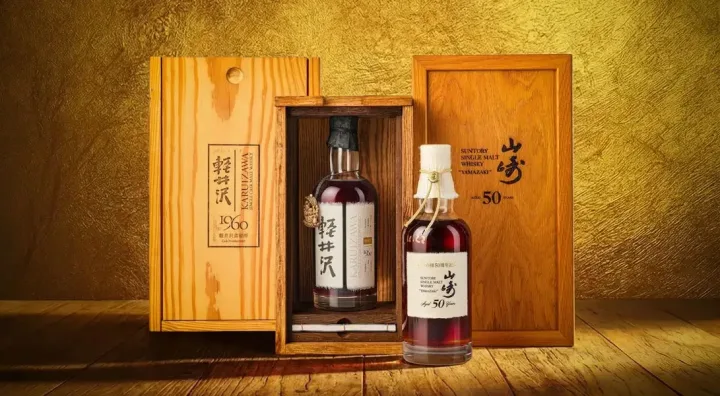
Japanese whisky is once again taking centre stage in the international market for major auctions.
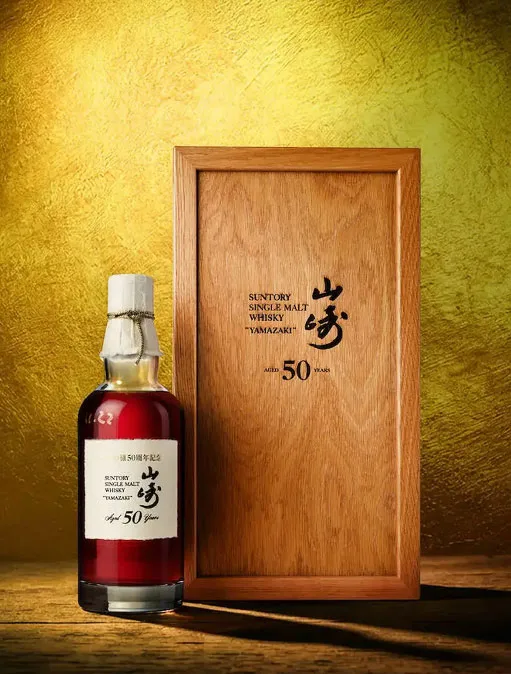
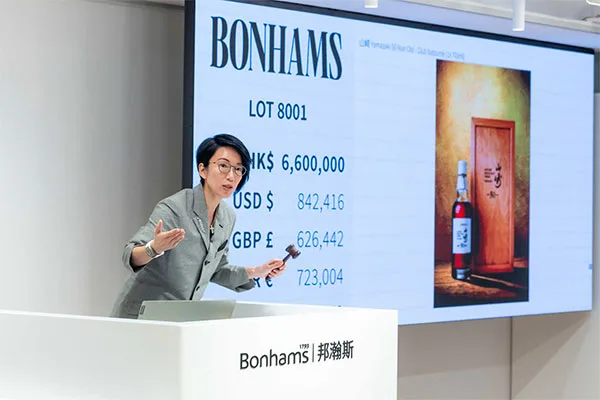
A singular bottle of Yamazaki 50 Year Old, created for a private club in Nagoya and separate from the brand’s usual commercial releases, reached a record figure yesterday, 30 May, in Hong Kong at the Bonhams auction house: HK$8.25 million for a single bottle of Japanese whisky, around 1.69 million yen according to the conversion cited by the original source.
Beyond the impact of the figure itself, the result offers an interesting reading for collectors and enthusiasts: at the very top of the market, a whisky’s age is no longer the only element that determines its value. Provenance, documented history and the status of a truly unrepeatable piece carry as much weight as the years of maturation, and can even tip the balance above officially older expressions.
A bottle outside the commercial circuit
Yamazaki 50 Year Old is one of the most recognisable names among the great Japanese single malts. The Yamazaki distillery, owned by Suntory and located near Kyoto, is regarded as one of the birthplaces of modern Japanese whisky. Its style combines Scottish influence with a character of its own, especially visible in the use of different cask types and in the pursuit of aromatic balance.
The auctioned bottle, however, was not part of the well-known Yamazaki 50 Year Old editions released by Suntory at different times. It is a piece produced for “Natsume”, a private club in Nagoya linked to high-end Japanese hospitality, to mark an internal celebration. According to the available information, it never reached the retail market and remained in private hands for years.
That nuance completely changes how it should be understood. This is not a rare bottle in the conventional sense, but an object with a specific, documented and highly limited provenance. The Japanese paper label and the signature of Suntory’s chief blender reinforce its dimension as an archival piece, closer to historical collecting than to a simple luxury reference.
Why a 50-year-old bottle can surpass a 55-year-old
The result has drawn particular attention because it exceeds the previous high attributed to Yamazaki 55 Year Old, also sold in Hong Kong by Bonhams. At first glance, it might seem contradictory that a whisky with fewer years of ageing should achieve a higher valuation. But the auction market rarely follows a linear logic.
In the very highest-end categories, the factors that carry the greatest weight usually combine several elements:
- Provenance: who commissioned, received or preserved the bottle can add historical value.
- Real availability: an officially distributed limited edition is not the same as a bottle created for a specific recipient.
- Condition and traceability: preservation, documentation and continuity of ownership are essential.
- Brand and distillery: Yamazaki remains a global benchmark for Japanese whisky.
- Collector narrative: pieces with a clear story tend to attract more competitive bidding.
In this case, the value lies not only in the fact that the liquid spent half a century in cask, but in the way the bottle distils a very specific story within Japanese whisky culture, private hospitality and international collecting.
Yamazaki, mizunara and the prestige of Japanese single malt
The source points to the use of mizunara oak in the maturation process, a key detail in understanding the allure of bottles of this kind. Mizunara, a highly prized Japanese oak that is notoriously difficult to work with, is associated with distinctive aromatic profiles: spicy notes, incense, fine wood, coconut, sandalwood and oriental nuances that have helped shape the identity of some of Japan’s great whiskies.
It is worth avoiding oversimplification: a whisky’s character is not defined by wood alone, but also by distillation, the maturation climate, cask selection and blending. Even so, in the imagination of international collectors, the word mizunara has become a powerful draw, especially when linked to Yamazaki and long ageing.
Over the past two decades, Japanese whisky has moved from being a cult category among connoisseurs to one of the most coveted segments in premium spirits. International recognition, the scarcity of aged stocks and the quality of houses such as Yamazaki, Hakushu, Hibiki, Yoichi and Karuizawa have fuelled demand that, in some cases, has outgrown the traditional drinking market.
Karuizawa confirms the appetite for extreme rarities
The same auction included another bottle of exceptional interest: a 52-year-old Karuizawa 1960, drawn from a specific cask and tied to one of Japan’s most legendary closed distilleries. Karuizawa, now closed and over time transformed into legend, holds a special place among collectors because its remaining stocks are finite. Every bottle opened or sold is a reminder that there will be no new production under the same historic conditions.
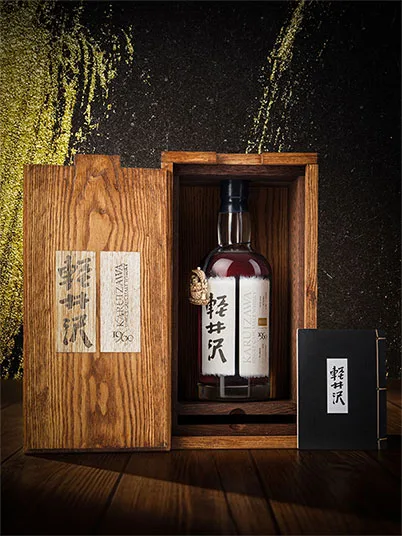
That two Japanese bottles reached extraordinary figures in the same session underlines the strength of demand at the very top end. This is not necessarily a broad recovery in the market, but rather a concentration of interest around bottles with an impeccable narrative and a level of rarity that is hard to replicate.
A more selective market
The current climate is less euphoric than in previous years. After the rise of whisky as an alternative asset, many auctions have shown signs of cooling: slower turnover, more cautious buyers and corrections in references that had climbed rapidly. Indiscriminate speculation has lost momentum.
However, the results for Yamazaki and Karuizawa point to clear segmentation. Rare but relatively familiar bottles may undergo adjustments; exceptional pieces, with unique provenance and proven prestige, continue to attract international capital. The market seems increasingly able to distinguish between commercial scarcity and historical singularity.
For enthusiasts who see whisky as a drink meant to be enjoyed in the glass, figures like these can be hard to process. A bottle of this calibre is probably not bought to be opened, but to enter a collection, an investment portfolio or a heritage narrative. That is where the familiar tension arises between liquid culture and luxury object.
What this record tells us about Japanese whisky
The new high does more than confirm Yamazaki’s power as a global brand. It also shows that Japanese whisky has consolidated its own language in the collectors’ market: precision, scarcity, design, provenance and a very close relationship with craft and ritual.
For Suntory and for the international image of Japanese whisky, the symbolic impact is clear. But the main lesson goes beyond any single distillery: in elite auctions, a bottle is worth as much for what it contains as for the story it can tell. And when that story is unique, the price can stop obeying any simple comparison.