
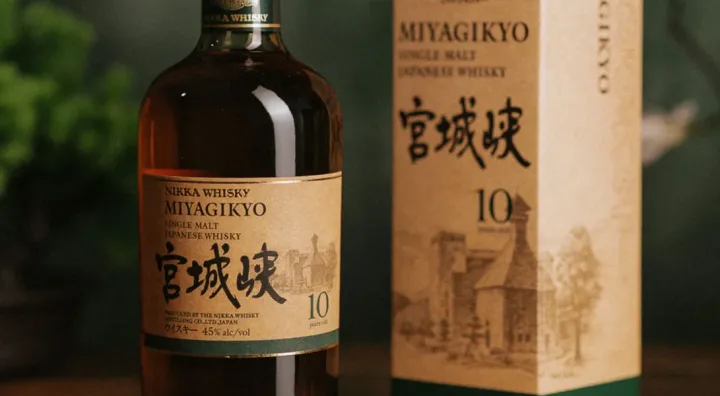
The return of an age-statement whisky is rarely just another catalogue update. In the case of Nikka Miyagikyo Single Malt 10 Year Old, it is also a meaningful signal for those following the evolution of Japanese whisky closely: after years shaped by shortages, some distilleries are beginning to bring back expressions that had slipped beyond consumers’ reach, as we recently noted with the return of Hibiki 12 Year Old whisky.
Miyagikyo, one of Nikka’s two major malt distilleries, is once again putting a ten-year-old expression centre stage after it had been absent from regular availability since the middle of the last decade. The news is interesting not only because of the product itself, but also because of what it represents within a category where international demand has long exceeded the industry’s ability to replenish stocks.
A key distillery on the Japanese whisky map
Miyagikyo Distillery is located in Miyagi Prefecture, in a humid, mountainous setting that contrasts with the more maritime and austere profile of Yoichi, Nikka’s other great malt distillery. Established as the company’s second production site, Miyagikyo has historically been associated with a more delicate, fruity and elegant style.
Its character is often described through notes of white fruit, apple, gentle citrus, sweet cereal and a texture that is less robust than that of other Japanese single malts with smokier or more saline profiles. That identity is not only the result of climate or location, but also of the distillery’s technical approach, which combines malt production in traditional pot stills with Nikka’s long-standing expertise in blending.
In Japanese whisky, the role of the master blender is decisive. Producers typically work with different cask types, distillate styles and aromatic profiles to achieve balance, precision and continuity. Miyagikyo fits especially well into that philosophy, offering malts with a clean, expressive aromatic base that can be interpreted in different ways depending on maturation.
Why so many age statements disappeared
During the years of global expansion for Japanese whisky, many brands were forced to rethink their ranges. International popularity grew quickly, but whisky needs time, and mature stocks cannot be created on demand. When demand exceeds the production forecasts made a decade earlier, distilleries have few options: reduce allocations, withdraw expressions or replace them with no-age-statement whiskies.
That happened in Japan, as well as in other producing countries. In Nikka’s case, several age-statement expressions were removed from the market or became highly restricted. Miyagikyo did not disappear as a single malt, but for years it did lose the ten-year-old version that helped give enthusiasts a clear benchmark for maturation.
The return of Miyagikyo 10 Year Old should therefore be viewed with a degree of caution. It does not mean abundance has suddenly returned, nor that age-statement Japanese whisky is once again widely available. Rather, it points to a selective recovery, with controlled releases and distribution that is likely to remain limited depending on the market.
A 10 year old shaped by diverse casks
The new edition of Miyagikyo Single Malt 10 Year Old has been presented as a blend of whiskies matured in different types of wood, including refill casks, sherry butts and new American oak. This combination allows several aromatic layers to come into play: the fruit character of the distillate, the spiced sweetness of new wood, the dried fruit or raisin nuances sherry can bring, and a rounder foundation from casks previously seasoned with whisky.
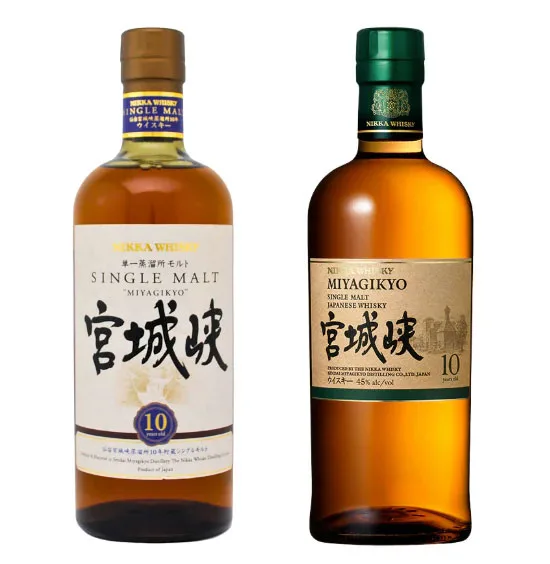
In terms of style, it is not necessarily worth expecting a heavy single malt. Miyagikyo has built its reputation on finesse and fruit rather than sheer power. Ten years of ageing can bring depth, better alcohol integration and greater breadth on the palate, without erasing the distillery’s bright, luminous identity.
The tasting notes shared by the brand point to aromas of apple, citrus and sweet vanilla, with a palate where malt and ripe fruit come together. It is a description that fits Miyagikyo’s classic image: a polished Japanese whisky, approachable aromatically, yet with enough complexity to appeal to experienced drinkers.
The value of an age statement in today’s Japanese whisky
In a landscape dominated by releases without an age statement, seeing “10 years” back on the label carries clear symbolic weight. Age is not everything in whisky, and there are excellent NAS expressions —with no age indication—, but a maturation statement offers transparency and places the product within a tradition that consumers readily recognise.
It also helps to understand the distillery’s positioning. A ten-year-old single malt is not trying to compete with much older malts or experimental single-cask editions; it usually sits at a point of balance between freshness, complexity and consistency. At Miyagikyo, that role is especially interesting because it allows the house character to show without the oak taking over completely.
How to enjoy a Miyagikyo 10 years old
To appreciate a whisky of this profile, it is best to avoid serving it too cold. A tulip-shaped glass or tasting copita helps concentrate the fruity aromas and cereal notes. It can be enjoyed neat, after a few minutes’ rest in the glass, or with a few drops of water if you want to open up its more floral and spicy side.
When it comes to pairing, Miyagikyo tends to work well with delicate flavours that do not overwhelm its profile:
- Delicately oily fish, such as salmon or marinated mackerel, especially with a citrus accent.
- Semi-cured cheeses of moderate intensity, which support the texture without dominating it.
- White chocolate or apple-based desserts, where the fruit and vanilla notes find a natural echo.
- Toasted nuts, a simple option for highlighting the cereal and oak.
It may also be an appealing whisky for those coming to Japanese single malt from lightly peated Speyside or Highland Scotch styles, although its Japanese precision and aromatic lightness give it a character of its own.
A comeback with an eye on the future
The reappearance of Nikka Miyagikyo Single Malt 10 Years Old should not be seen merely as the return of a long-awaited bottle. It is also a sign of how the major Japanese houses are managing the difficult balance between prestige, stock levels and international demand.
For enthusiasts, it represents the chance to reconnect with a classic age statement within the Nikka universe. For the category, it confirms that Japanese whisky continues to mature not only in cask, but also as a market: more aware of its limitations, more careful with its releases and increasingly watched by collectors, bartenders and drinkers around the world.