
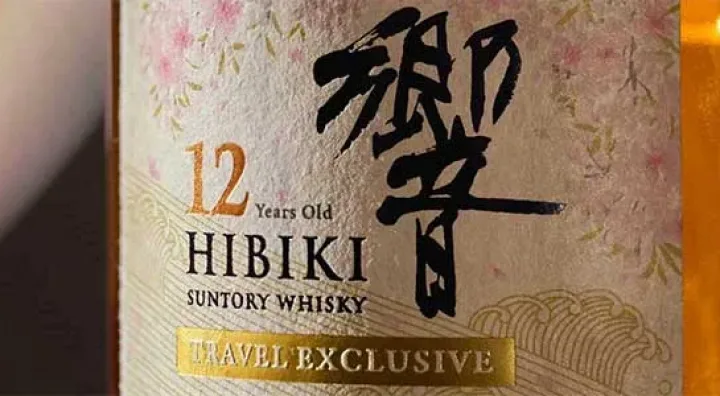
The return of Hibiki 12 Year Old is one of those stories that goes well beyond the launch of a bottle. For many lovers of Japanese whisky, this Suntory blend represents a very specific period: the international rise of Japan as a source of high-end whisky and, at the same time, the beginning of a shortage that would shape the entire category for more than a decade.
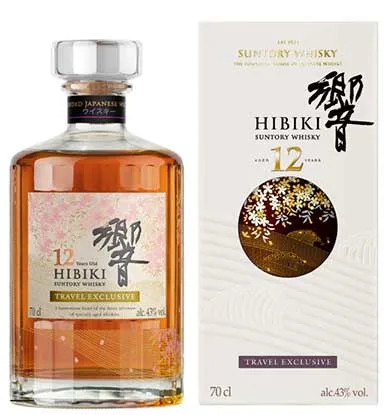
According to information reported by specialist Japanese media, Suntory has decided to bring back Hibiki 12 Year Old as a release intended for the global travel retail channel, namely duty-free stores in international airports. Distribution is expected to begin in some of the major airport hubs before expanding to other international markets within that circuit. For now, no wider rollout to traditional retail has been announced.
A meaningful comeback for age-statement Japanese whisky
The significance of this move is best understood in context. During the years when Japanese whisky grew most rapidly overseas, age-statement expressions became highly sought-after. The problem was clear: demand was growing much faster than the ability to replenish aged stocks.
In whisky, time cannot be rushed without consequences. When a bottle states 12, 17 or 21 years, the youngest whisky it contains must have spent at least that length of time maturing in cask. If production planned years earlier is not enough to meet a sudden surge in demand, a distillery has few options: reduce allocations, reshape its ranges, focus on no-age-statement whiskies, or temporarily withdraw certain expressions.
That is precisely what happened to several prestigious Japanese labels. Hibiki 12 Year Old disappeared from the market in the past decade and, since then, its presence gradually shifted to the secondary market, where bottles became sought-after pieces for collectors and enthusiasts.
Hibiki: the Japanese idea of harmony applied to blended whisky
Hibiki holds a special place in Suntory’s portfolio. Created as a premium Japanese blended whisky brand, its identity has been built around the word that gives it its name: “resonance” or “harmony”. This is not merely a poetic statement. In the world of blended whisky, the aim is to bring together malt and grain whiskies from different origins, styles and cask types to create a balanced whole.
For Suntory, that architecture rests on three essential pillars: Yamazaki, the historic malt distillery near Kyoto; Hakushu, associated with a greener, fresher, mountain-like profile; and Chita, which specialises in grain whisky. The combination of these styles makes it possible to create whiskies with a silky texture, clean aromas and a profile in which complexity is usually expressed not aggressively, but in successive layers.
The relaunch of Hibiki 12 Year Old should not necessarily be read as a simple recreation of the whisky many remember. The very nature of blended whisky involves ongoing interpretation: stocks change, casks evolve differently, and the master blender must work with the components available while preserving an idea of style.
A new interpretation under Shinji Fukuyo
The Japanese source indicates that this new version has been reinterpreted by Shinji Fukuyo, Suntory’s fifth chief blender. That nuance matters. To speak of reinterpretation is to acknowledge that the goal is not to clone a bottle from the past, but to recover its concept and adapt it to the current reality of the house’s reserves.
The composition follows Hibiki’s familiar logic: malt and grain whiskies from the Suntory universe, matured in different types of oak. Within the company’s repertoire, American oak, Spanish oak and the prized mizunara all play an important role. Mizunara is a Japanese oak that is difficult to work with and is closely tied to the aromatic imagination of Japanese whisky, thanks to its notes of spice, incense, aromatic wood and an oriental undertone.
This diversity of casks is key to understanding Hibiki’s profile. American oak can bring vanilla, coconut, sweet fruit and creaminess. Spanish oak tends to offer greater depth, hints of dried fruit, spice and a certain oxidative richness. Mizunara, when well integrated, adds a more ethereal, perfumed dimension. The blender’s challenge is to ensure that none of these voices dominates too strongly.
Announced sensory profile: fruit, spice and aromatic wood
The tasting notes released for this new edition point to an expressive yet measured style. On the nose, nuances of persimmon, jasmine, cardamom, orange and sandalwood are mentioned. On the palate, the description moves towards spiced orange peel, cinnamon and butterscotch, with a long, spicy finish.
Beyond the literal tasting notes, what is interesting is the aromatic territory they suggest: ripe fruit without excessive weight, delicate florality, sweet spice and aromatic wood that could connect with the most recognisable identity of high-end Japanese blends. On paper, it is a profile that suits a whisky to be enjoyed neat, with a little water, or served very carefully over quality ice.
Why travel retail is a strategic route
The fact that Hibiki 12 Year Old is returning first through travel retail does not seem accidental. The airport channel allows major houses to control volumes more effectively, gauge international response and reinforce a brand’s global image. For an age-statement expression, that caution can be decisive.
There is also a symbolic element. The international traveller has played a crucial role in spreading Japanese whisky: bottles discovered in airports, purchases brought back from Japan, and duty-free exclusives have all helped create a culture of searching around brands such as Hibiki, Yamazaki and Hakushu. In that sense, travel retail acts both as a worldwide showcase and as a barometer of demand.
The drawback is obvious: this kind of release is not always accessible to local consumers or to those who usually buy from specialist retailers. If the expression does not reach broader channels, its availability may remain limited to travellers and to markets with strong international turnover.
Design and aesthetics: the bottle as part of the story
With Hibiki, the vessel has always carried narrative weight. Its distinctive faceted bottle is part of the brand’s visual identity and connects with a Japanese sensibility in which presentation is far from secondary. For this new stage, the available information refers to inspiration drawn from motifs linked to nature, the seasons and certain elements of traditional Japanese architecture.
That visual language is not incidental. Suntory has succeeded in building a recognisable universe around Hibiki: refinement, balance, seasonality and a sense of understated luxury. In a global market saturated with new releases, aesthetic consistency can reinforce the perception of a brand just as much as its organoleptic profile.
How to enjoy a whisky like Hibiki 12 Year Old
A Japanese blend of this style lends itself to several serves. The most direct option is to drink it in a whisky glass or tulip-shaped glass, allowing a few minutes of aeration so that the floral and spicy notes can emerge. Adding a few drops of water may open up the whisky and soften the alcoholic presence, especially if a more aromatic reading is desired.
With ice, it is best to avoid small cubes that dilute too quickly. One large, dense piece will preserve the balance better. And although many enthusiasts save bottles of this kind for drinking neat, the cultural importance of the Japanese highball should not be overlooked: whisky, very cold soda, quality ice and precise execution. With scarce or high-priced expressions, each drinker will decide whether they prefer to keep the whisky for a slower tasting experience.
For food pairing, profiles such as Hibiki’s tend to work well with dishes of medium intensity: oily fish, lacquered poultry, mushrooms, mild aged cheeses, nuts, or desserts with citrus and caramel. The key is not to overwhelm its aromatic delicacy.
A signal for the category, not an immediate solution
The return of Hibiki 12 Year Old can be seen as a positive sign for Japanese whisky, but it should be read with caution. When a distillery brings back an age-statement label, it suggests a greater ability to manage stocks, but it does not necessarily mean abundance. Maturation still follows its own timeline, and Japanese brands continue to operate in a context of very high international demand.
For Suntory, this move strengthens Hibiki’s position as one of the great references in contemporary blended whisky. For enthusiasts, it offers the possibility of seeing an emblematic age statement associated with the brand once again. And for the market, it confirms that the segment of age-statement Japanese whiskies still has extraordinary appeal, both for its perceived quality and for its cultural and collectible weight.
It remains to be seen whether Hibiki 12 Year Old will eventually reach other channels or remain tied to the international airport circuit. In any case, its return already marks a new chapter in the recent history of Japanese whisky.