
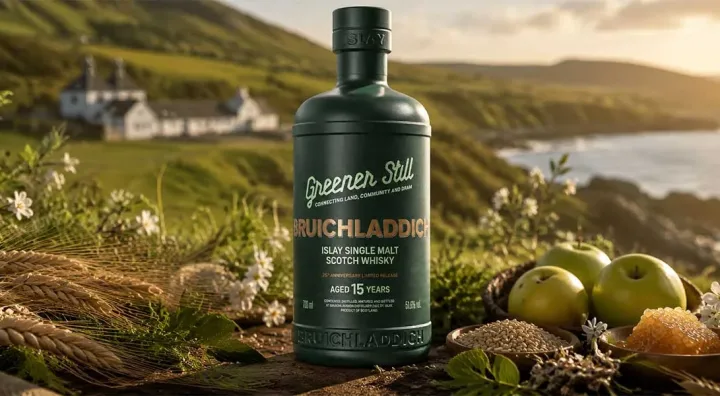
Bruichladdich once again moves the conversation around Scotch whisky beyond the cask. With Bruichladdich Greener Still, the Islay distillery offers an interpretation of single malt focused on the agricultural origin of the spirit, the diversity of barley and sustainability as part of a whisky’s character, not merely as corporate messaging.
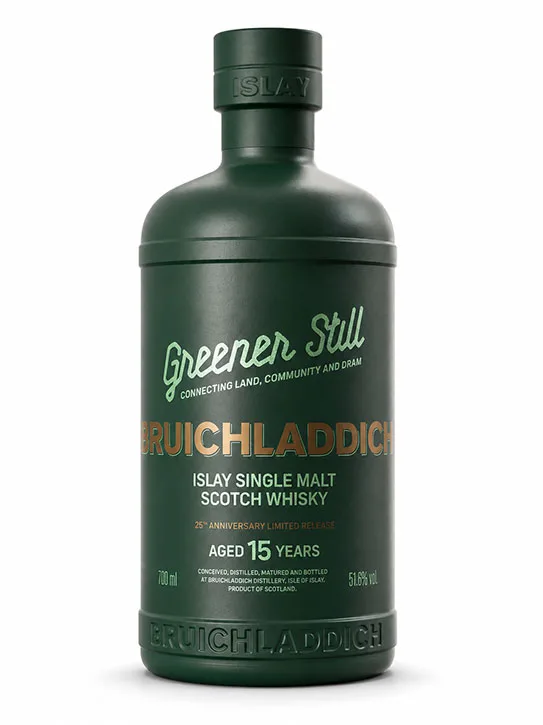
The new release is presented as a limited edition linked to the celebration of 25 years since the distillery’s modern revival. It is an unpeated single malt Scotch whisky, aged 15 years, bottled at 51.6% ABV and matured in first-fill bourbon casks. Yet what matters most is not only its age or its cask profile, but the selection of grains used to make it.
A whisky that looks to the field before the wood
Over recent decades, much of whisky’s vocabulary has been built around maturation: American oak, sherry, wine, virgin casks, special finishes. Bruichladdich Greener Still deliberately shifts the focus of the conversation. Here, the cask acts as a frame, while barley takes centre stage.
The distillery has used a combination of organic barley, biodynamic barley and Bere barley, an ancient variety historically associated with northern Scotland and the islands. Each one reflects a different idea: reducing dependence on artificial inputs, exploring lower-impact farming models and preserving genetic diversity in a crop that is fundamental to whisky.
The organic barley comes from mainland Scotland and is grown without synthetic fertilisers or pesticides. The biodynamic barley comes from Yatesbury House Farm in Wiltshire, an exception to Bruichladdich’s usual policy of working with Scottish barley. Bere, meanwhile, is grown in Orkney in collaboration with agronomic research institutions, reinforcing both its heritage value and its experimental dimension.
Bruichladdich and Islay’s unpeated identity
Talking about Islay almost automatically brings intensely smoky whiskies to mind. Bruichladdich, however, has always played with that expectation. The house produces very different styles: from heavily peated expressions under other distillery lines to unpeated single malts that aim to show the clarity of the grain, fermentation and the maritime influence of the surroundings.
Greener Still belongs to that unpeated tradition. Rather than leaning on smoke, ash or medicinal notes, the whisky moves towards a cleaner, more floral, fruity and cereal-led palette. First-fill bourbon casks usually contribute vanilla, coconut, oak sweetness, gentle spice and ripe fruit, but in this case the stated intention is for them not to obscure the personality of the raw material.
The continuation of a historic series
The new edition joins the conceptual family of Bruichladdich’s Still Series, a collection remembered for its experimental approach to maturation and the influence of different types of oak. In those releases, the focus was on how specific casks could shape the character of the spirit.
Greener Still introduces a different reading: colour no longer points so much to wine, sherry or bourbon, but to a broader concern with cultivation, traceability and environmental impact. It is a logical evolution for a distillery that has made barley provenance and production transparency an essential part of its story.
Sustainability in whisky: from message to production
The launch comes at a time when the Scotch whisky industry faces clear challenges: energy consumption, transport, water use, by-product management, intensive agriculture and emissions reduction. Traditional distilleries, many of them housed in historic buildings, do not always start from facilities designed for modern environmental efficiency.
Bruichladdich has acknowledged this starting point on various occasions: this is not a distillery originally designed around ecological principles, but a Victorian plant that has had to adapt processes, test solutions and move forward gradually. Among the areas of work associated with the house are regenerative agriculture, the study of lower-impact fuels, the use of organic waste and the search for renewable heating systems for distillation.
In the context of whisky, these advances are far from minor. Distillation requires heat, maturation involves long periods of storage, and the raw material depends directly on the health of the soil and the climate. That is why a whisky such as Greener Still is interesting not only for its sensory profile, but also for the conversation it opens about how single malts will be made in the coming decades.
Aromatic profile and tasting style
According to the information provided for this edition, Bruichladdich Greener Still sits in a register of soft flowers, orchard fruit, toasted oak, aromatic herbs and spiced sweetness. On the palate, notes of ripe pear, malted cereal, cinnamon, caramel, honeyed citrus and a broad texture are expected, with a creamy finish and a coastal nuance.
Given its strength, it can be enjoyed neat in a tulip glass, allowing enough time for it to open up. It also accepts a few drops of water, especially if the aim is to soften the alcoholic intensity and encourage floral, herbal or fruity nuances to emerge. It does not seem to be a whisky conceived for everyday cocktails, but rather for slow, considered tasting.
- Type: unpeated single malt Scotch whisky.
- Origin: Islay, Scotland.
- Maturation: first-fill bourbon casks.
- Highlighted grain: a combination of organic, biodynamic and Bere barley.
- Profile: floral, fruity, cereal-led, spicy and influenced by American oak.
An edition that shows where Scotch is heading
Bruichladdich Greener Still completes a series of commemorative releases linked to the distillery’s recent anniversary. Beyond its limited-edition status, its interest lies in the way it connects three themes that carry increasing weight in contemporary whisky: agricultural origin, transparency and environmental responsibility.
Not every consumer looks for the same kind of innovation. Some focus on unusual casks; others on high age statements or collectible rarities. Greener Still speaks to an audience that wants to understand what comes before distillation, how barley is grown and which decisions can influence a whisky’s flavour from the soil upwards. In that sense, Bruichladdich once again uses Islay not as a smoky cliché, but as a platform for rethinking Scottish single malt.
Approximate retail price: 120 euros.