
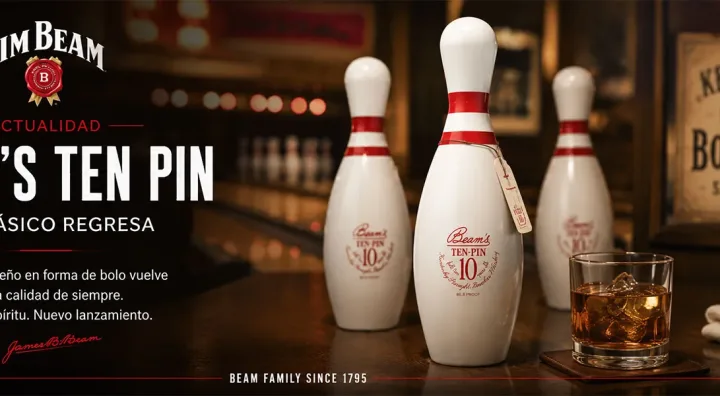
Jim Beam is once again looking to its own archives to bring back one of those pieces that helps explain why American bourbon is not only something to drink: it is also collected, given as a gift and kept as part of a highly recognisable popular culture.
The Clermont, Kentucky house has announced the return of its Ten-Pin decanter, a bowling pin-shaped bottle that ties directly into a very North American tradition: whiskey as a bar object, family keepsake and conversation piece.
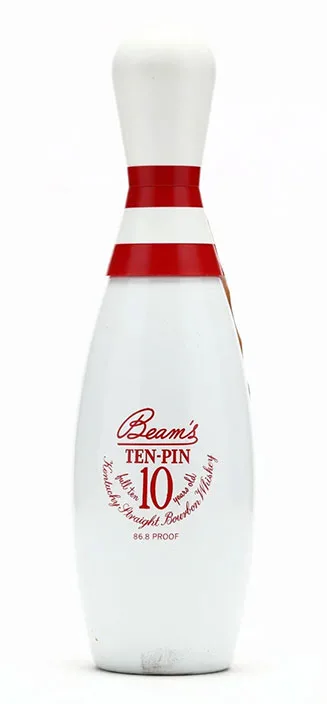
The reissue is not limited to the exterior design. Inside, Jim Beam has chosen a 10-year-old Kentucky Straight Bourbon at 100 proof (50%Vol), a classic strength in bourbon terms that is often associated with expressions offering more body, greater presence on the palate and a structure suited both to sipping neat and to enjoying slowly.
A decanter that speaks of bourbon and popular culture
The relationship between whiskey brands and decorative decanters played a prominent role through much of the 20th century. Bottles shaped like cars, animals, historical figures or sporting themes were common at a time when the vessel itself formed part of the product’s appeal. In that context, the Jim Beam bowling pin became a piece remembered by enthusiasts and collectors alike.
The return of the Ten-Pin Decanter fits neatly into a current trend in the sector: reviving heritage elements with a contemporary approach. The major bourbon distilleries are revisiting their history not only through recipes and labels, but also through formats that evoke a particular way of understanding the American home bar.
In this case, the connection with bowling is no cultural accident. For decades, bowling has been a social setting closely tied to popular leisure in the United States, especially in communities across the Midwest and the South. Turning a bourbon into an object associated with that imagery reinforces Jim Beam’s approachable, recognisable character without giving up a clearly collectible presentation.
What a 10-year-old, 100 proof bourbon brings
Beyond the packaging, the key detail for whiskey enthusiasts lies in the choice of liquid. A 10-year-old Kentucky Straight Bourbon implies extended maturation by the category’s usual standards, in this case using charred American oak barrels.
In Kentucky, where hot summers and cold winters accelerate the interaction between spirit and wood, a decade in barrel can bring a notable layer of oak, sweet spice and toasted notes.
The Kentucky Straight Bourbon designation requires, among other things, production from a grain mixture with a majority of corn, distillation and ageing under the rules governing American bourbon, and maturation in new charred American oak barrels. That new wood is essential to understanding its profile: vanilla, caramel, coconut, toast, baking spices and ripe fruit are often part of the category’s aromatic register.
According to the description released by the brand, this expression shows a profile marked by oak, toasted vanilla, baked bread and caramel on the nose. On the palate, it moves towards toffee, toasted wood, sweet spices and dried fruit, with a warm, lingering finish. Without turning it into a closed tasting note, everything points to a bourbon designed to have presence and to hold interest beyond the curiosity of the decanter.
Jim Beam, Clermont and the weight of a family in bourbon
Jim Beam is one of the essential names for understanding bourbon’s global expansion. Its identity is closely tied to Kentucky and, in particular, to Clermont, where the James B. Beam Distilling Co. keeps its production site and brand experience hub. The company has built much of its story around family continuity, a recurring theme in American whiskey but an especially visible one in Beam’s case.
Freddie Noe, eighth-generation Master Distiller, has presented this reissue as a way to honour a piece of the house’s history while giving it a bourbon in line with today’s expectations. That blend of nostalgia and liquid quality is crucial: today’s buyer of a special edition is rarely satisfied with a striking package if the contents do not stand up on their own.
The decision to bottle a bourbon with an age statement and a higher proof than the entry-level expressions reinforces that idea. In a market where limited-edition bourbons attract enormous attention, especially in the United States, the balance between storytelling, design and technical specifications is decisive.
A piece designed for collectors
The Ten-Pin Decanter sits firmly in the realm of collectible bottles. Its availability is linked to the American Outpost at the James B. Beam Distilling Co. in Clermont, at a suggested price of $124.99, adding a distillery-visit and bourbon tourism element. Releases of this kind generate excitement not only around the product itself, but also reinforce Kentucky’s appeal as a destination for whiskey enthusiasts.
For European consumers, the announcement is interesting even if availability is restricted. It shows where part of the American premium bourbon segment is heading: editions with a strong historical charge, distinctive packaging, higher-character proofs and a narrative deeply rooted in place of origin.
How to enjoy a bourbon of this profile
A 100 proof, long-aged bourbon is usually best served without rushing. It can be enjoyed neat in a rocks glass, with a few minutes to rest so it can open up aromatically, or with a few drops of water if you want to soften the alcohol intensity and encourage sweeter, spicier nuances to emerge. A large ice cube can also work, although excessive dilution is best avoided if you want to preserve its structure.
In cocktails, a bourbon with oak and spice can shine in classics such as an Old Fashioned or a Manhattan, provided the aim is not to hide its personality. Even so, with a piece like this, the first pour will probably call for a simple, more contemplative tasting, where the decanter and the spirit share the spotlight.
The return of the Ten-Pin Decanter confirms that bourbon also lives through memory, symbols and objects. Jim Beam brings back a recognisable shape from its past and pairs it with a whiskey of serious specifications.
For some, it will be a decorative rarity; for others, the perfect excuse to talk once again about Kentucky, charred barrels and a category that continues to gain weight in international drinks culture.