
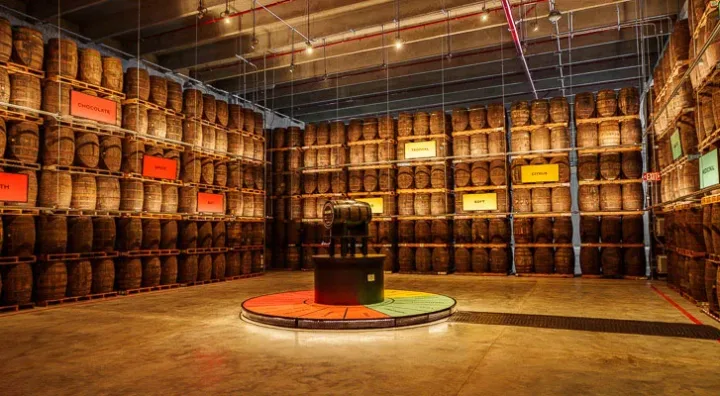
Bacardí has taken a significant step in how it tells its story to consumers. For the first time, the company has opened access to its ageing warehouses in Puerto Rico to the general public, as part of a new experience at Casa Bacardí, the visitor centre located in Cataño, across the bay from San Juan.
The initiative comes at a symbolic moment for the brand, which is celebrating nine decades of activity in Puerto Rico and strengthening its maturation capacity with new facilities. Beyond the corporate announcement, the move is interesting for what it reveals about an increasingly visible trend in the sector: major spirits houses want to show not only the finished bottle, but also the places where time, wood and blending define the character of the product.
The warehouse as an essential part of rum
In rum, ageing is not a decorative formality. It is a decisive stage in which the distillate evolves through contact with the cask, absorbs compounds from the wood and develops nuances that may recall vanilla, spices, nuts, cocoa or caramel, depending on the type of barrel, environmental conditions and resting time.
Puerto Rico, like other Caribbean regions, offers a warm, humid climate that accelerates certain maturation processes compared with colder areas. The interaction between alcohol, wood and oxygen is more intense, and evaporation also plays an important role. This phenomenon, known in many cellars and distilleries as the “angel’s share”, is part of the common language of spirits ageing.
For a large-scale brand to allow visitors into these spaces brings them closer to a dimension normally reserved for master blenders, technical teams and industry professionals. It is not simply about seeing stacked barrels: it is a way of understanding that rum is shaped as much by distillation as by the patience that follows.
Casa Bacardí expands its tourism offering
The new visit, called Maestro’s Walk, offers a tour focused on the work behind rum blending. The concept revolves around the figure of the maestro, responsible for safeguarding the house style and deciding how different batches are combined to maintain consistency, complexity and personality.
During the experience, visitors access areas connected with ageing and can gain a more direct understanding of how the cask, time and blending influence the final profile of a rum. There is also the possibility of tasting rum straight from the barrel, a particularly revealing practice because it allows visitors to perceive a distillate before its final adjustment and preparation for bottling.
This type of visit goes beyond a conventional tasting. It places the consumer where rum is transformed and helps explain why two expressions from the same brand can show different styles. Some are designed for lightness and versatility in cocktails; others lean towards rounder profiles, intended to be enjoyed neat or over ice.
Puerto Rico, a key hub for Bacardí
Bacardí’s relationship with Puerto Rico is part of the company’s modern history. The firm was founded in Santiago de Cuba in the 19th century by Don Facundo Bacardí Massó, and decades later expanded its production beyond Cuba, with Puerto Rico becoming one of its main hubs. Today, the Cataño facility is presented as one of the world’s major references in premium rum production.
The complex is not only industrially significant. Casa Bacardí has for years served as a meeting point between tourism, the brand and cocktail culture. Its proximity to San Juan has made it a regular stop for travellers interested in the history of Caribbean rum, classic mixology and the role this spirit plays in the island’s gastronomic identity.
The opening of the ageing warehouses reinforces that experiential dimension. In a market where consumers increasingly value origin, processes and traceability, showing the place where rums mature helps build a more tangible narrative than a simple tasting room can offer.
Investment, sustainability and maturation capacity
The expansion includes new warehouses dedicated to ageing, as well as improvements to the visitor experience. According to the company, these facilities incorporate technology and recycled materials with the aim of reducing impact and improving efficiency. The recent investment in Puerto Rico is part of a broader plan to grow and modernise its production capabilities.
In the rum sector, having greater ageing capacity is a strategic issue. Time cannot be accelerated indefinitely without compromising style, and brands working with aged rums need to anticipate their future needs years in advance. More barrel space also means greater scope to select batches, experiment with profiles and ensure continuity across established ranges.
Sustainability, meanwhile, has become a cross-cutting priority for the spirits industry. From the efficient use of water and energy to waste management, lighter packaging and the reuse of materials, distilleries are under increasing pressure to show that industrial growth can coexist with a smaller environmental footprint.
The rise of distillery tourism
What is happening at Casa Bacardí is part of an international trend. Whisky distilleries in Scotland, cognac houses in France, tequila producers in Jalisco and sherry bodegas have all seen that visitors want to take part in, or at least observe up close, the rituals behind production.
In the case of rum, this tourism dimension has a particular appeal. The Caribbean offers a historical, agricultural and cultural setting deeply connected to sugar cane, maritime trade and tropical cocktail culture. Opening warehouses, explaining blends and showing barrels helps place rum in a more nuanced territory, far from the simplified idea of a spirit made only for celebration.
For enthusiasts, a visit of this kind can help refine their tasting judgement. Some aspects to look for in an aged rum include:
- The influence of wood on aromas of vanilla, spice or nuts.
- The balance between perceived sweetness, alcohol and mouthfeel.
- The difference between a rum designed for mixing and one intended for slow sipping.
- The role of blending in maintaining a brand’s consistent house style.
A perspective for rum consumers
The opening of these warehouses does not transform the category by itself, but it does confirm an important evolution: rum wants to talk more about origin, technique and maturation. For years, other spirits have occupied that ground more comfortably. Today, major rum brands are seeking to show the complexity of their processes and to highlight the expertise behind every blend.
For Bacardí, allowing the public through the doors of its ageing warehouses in Puerto Rico is a way to connect heritage with innovation. For visitors, it can be an opportunity to see rum differently: not only as an ingredient in a daiquiri or a mojito, but as a drink shaped by technical decisions, family memory and time in barrel.