
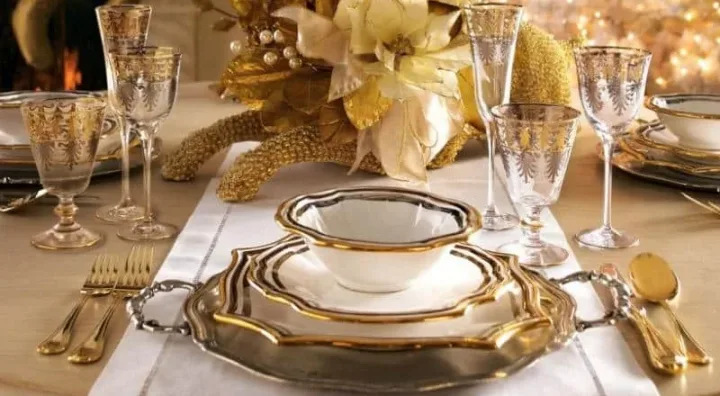
Let us look at essential aspects of table protocol, rules and etiquette
Today we are going to talk about table protocol. It is important to know the rules and etiquette that apply when sitting at a formal table, because they often feel intimidating. We fear not remembering everything and making a mistake. Here is information about different utensils and some basic rules for setting a table.
First, we need to know most of the elements that will be on the table and then understand how to behave in a social or executive setting. Business meals are common, and suddenly you may sit down and find many pieces of cutlery without knowing where to begin.
Table protocol: the tablecloth
The first thing to consider when setting a table is the tablecloth. It should match the shape of the table and have a similar drop on all sides, roughly half the distance between the table and the floor.
 Formal dinner tablecloths have traditionally been white or very light, although that has changed. The important thing is that they must look perfectly clean and carefully ironed. There is no negotiation here: a wrinkled or stained tablecloth ruins any gathering.
Table protocol: the crockery
Next comes the crockery, meaning all the plates used at the table. The charger plate is usually the largest plate and is never used to eat from; it is decorative and gives the setting a different touch.
 There should always be a flat plate and a deep plate, even if only the deep plate is used. Deep plates are never placed alone. The charger, flat plate and deep plate are presented. Plates are separated by about 45 centimetres and 2 or 3 centimetres from the table edge. The bread plate goes at the upper left and may include a small butter knife.
Food is served from the left, unless it is already plated. Empty plates are removed from the right. Drinks are served without resting the bottle on the glasses, and glasses should never be lifted to be served.
The dinner plate can also support a deep plate for cream soups or liquid dishes. If there is no deep plate, only the dinner plate is set, and later a salad plate can be placed. The salad plate can also be used for dessert. The bread plate is the smallest and is designed for bread.
Table protocol: cutlery
Before using cutlery, it is necessary to know the order in which it is arranged, according to the order of use during the meal. Knives are placed on the right side of the plate in order of use. The fish knife is outside and the meat knife closer to the plate, both with cutting edge inward. The spoon is placed on the outer side, concavity upward, for soup or cream.
 Forks, with tips upward, go on the left side, also in order of use. The smaller fish fork goes outside and the meat fork closer to the plate. Dessert cutlery is placed at the top of the plate or brought when dessert is served. All pieces should be about 3 cm from the plate.
- The spoon is always used with the right hand for liquids such as soups and creams.
- The fork may be held in the right hand with tines upward for bringing food to the mouth or cutting soft foods.
- The knife is always handled with the right hand, edge downward, and can help push food onto the fork.
- Dessert cutlery is smaller and may include spoon, fork, or combinations depending on the dessert.
Once cutlery has been picked up, it should not be placed back on the table; it remains on the plate until service is cleared, in the correct position.
Table protocol: the salt shaker
The salt shaker has two possible places: mainly at the centre of the table, where guests must interact to request it, or in front of each place setting if possible.
Table protocol: napkins
Even protocol experts do not agree on where the napkin should be placed. What is clear is where not to place it: never inside glasses or between plates and glasses. It may be placed on the plate or to the left or right.
 Avoid leaving lipstick marks on napkins. According to table protocol, napkins are unfolded and kept on the lap during the meal, and once finished they are left to the right of the plate without folding.
Table protocol: glassware
In glassware, the largest glasses are water glasses and are placed more toward the centre of the diner. Since bread is on the left, the glasses balance the right side. Glassware gives elegance and movement to the setting. Water is placed toward the centre and wine to its right; if there are two wine glasses, one is for red and one for white.
- Important tips: never use the napkin only at the end, because it suggests not knowing how to eat. Posture should be upright; do not lean back. Ideally there is a palm’s distance between the table and the body and between the backrest and the body.
- undefined
The source also stresses that protocol is not only decorative; it helps the meal flow. The distance between plates, the place of the bread plate, the way drinks are served and the side from which plates are removed all prevent awkward movements. The guest should not try to help by lifting the glass, and should follow the rhythm of the service.
The dinner plate, salad plate and bread plate each have a function. A deep plate needs a supporting plate below it, while a salad plate can later serve for dessert when portions are smaller. This is why a formal table may look complex before service begins: it anticipates several courses and avoids improvisation.
The same applies to cutlery. The outer pieces are used first and the closest pieces later. Fish, meat, soup and dessert all have specific tools, but the practical rule is simple: work from the outside toward the plate and never return used cutlery to the tablecloth.
Napkins and posture close the lesson. The napkin is not decoration inside the glass; it belongs on the lap during the meal. A straight posture, without leaning back or crowding the table, allows the diner to eat comfortably and respectfully.
The original explanation also insists that formal service is not a memory test but a sequence. If the starter is soup, the spoon appears outside the knives; if it is salad, the spoon may disappear. If fish and meat are both served, the smaller fish cutlery is used first, and the larger meat cutlery later. Dessert pieces can wait above the plate or arrive with the dessert itself.
Another practical rule concerns the direction of service. A host or waiter serves food from the left when it is presented from a platter, while plated dishes may arrive from either side. Empty plates leave from the right. This avoids crossing movements and gives each diner enough space. Bread, meanwhile, remains on the upper-left bread plate, not on the tablecloth or main plate.
The article also warns against small gestures that seem helpful but break protocol: raising the glass while wine or water is poured, placing used cutlery on the cloth, or using the napkin only at the end. These details communicate whether the diner feels comfortable with formal etiquette.
You may be interested in table protocol: