
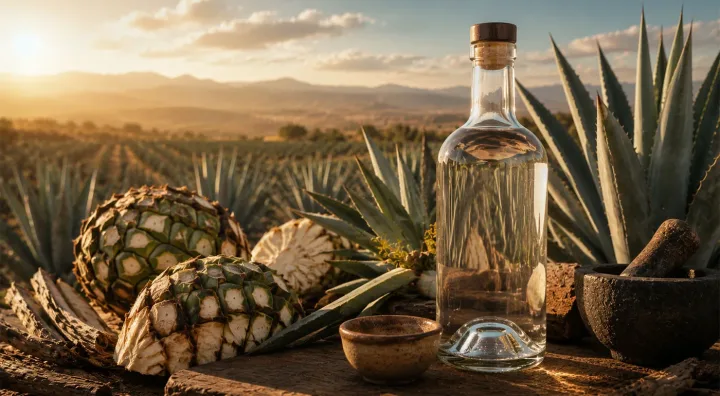
For years, mezcal has been introduced outside Mexico as “smoky tequila”. The comparison helps place it, but it falls far short. Mezcal is a vast family of agave spirits, closely tied to rural communities, methods passed down through generations, and a botanical diversity that is hard to find in other spirits.
Its international rise has brought many bottles into cocktail bars, contemporary Mexican restaurants, and specialist shops. It has also raised important questions: what is the difference between mezcal and tequila, why some producers prefer to call it agave spirit, what artisanal or ancestral means, and how best to drink it in order to understand its character.
What is mezcal?
Mezcal is a Mexican spirit made from agave, a plant also known as maguey.
The word itself evokes the idea of cooked agave, and that cooking process is key to understanding its identity. Unlike other spirits based on grains, fruit, or sugar cane, mezcal comes from the heart of a plant that can take many years to reach maturity.
There is no single “mezcal flavour”. Some expressions are dry, mineral, herbal, floral, fruity, earthy, or gently saline. Smoke may be present, but it should not necessarily be the dominant trait.
In the finest examples, it is woven in, like one more layer within a whole shaped by the agave, the soil, the climate, the water, fermentation, and the hand of the maestro mezcalero.
Agave, place, and culture
Mezcal is especially associated with Oaxaca, the state behind a large share of the best-known production. However, the designation of origin also recognises other Mexican regions, and traditional agave spirits exist in areas that do not always fit within today’s regulatory framework.
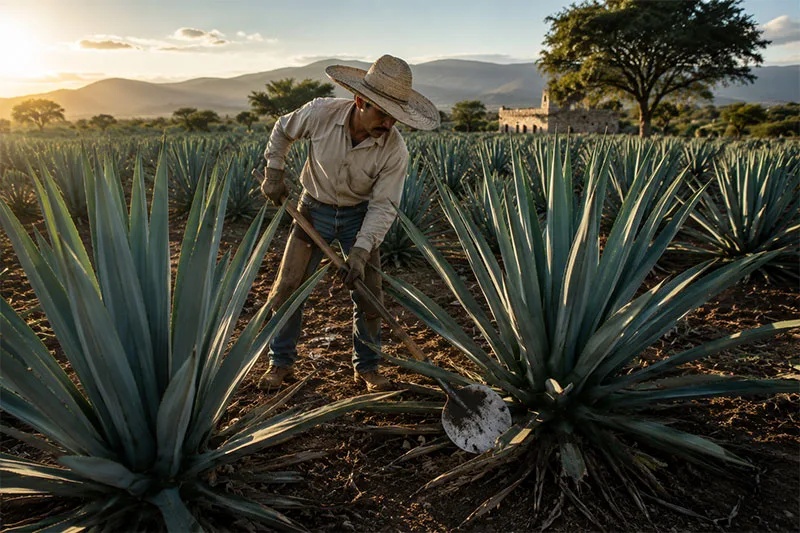
This matters because mezcal is not just a commercial category. In many communities, it forms part of celebrations, family rituals, meals, mourning, and social gatherings. Each batch can reflect a local practice: the type of oven, the way the agave is milled, the fermentation vessel, or the still used. In that sense, to speak of mezcal is to speak of place, but also of memory.
How mezcal is made
The process begins in the field, with the selection of mature agave. When the plant is ready, the leaves are cut away and the piña—the heart of the maguey—is obtained. This piña is chopped and traditionally cooked in pits dug into the earth and heated with stones and firewood. This stage brings roasted notes and, in many cases, a smoky undertone.
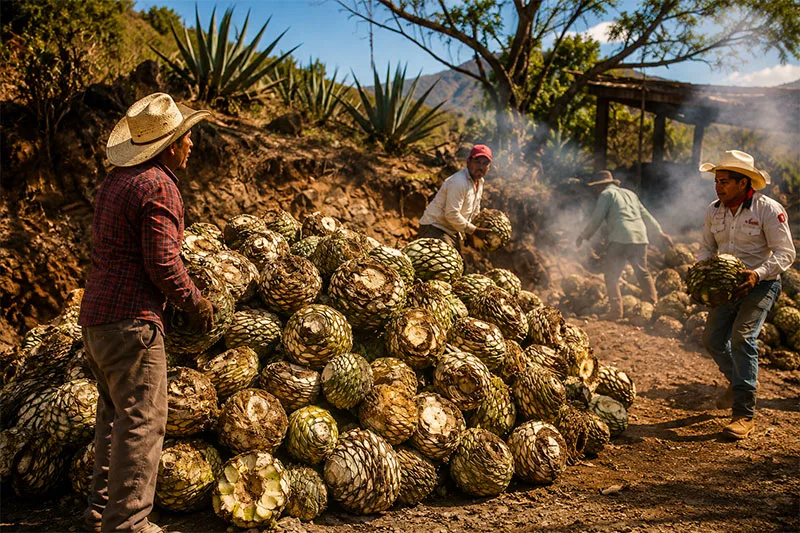
Afterwards, the cooked agave is crushed to extract its juices and fibres. Milling may be done using very traditional methods, such as mallets or a tahona, or with more modern systems, depending on the producer. The resulting mash ferments with water and yeasts present in the surrounding environment. This spontaneous fermentation is one of the reasons mezcal can show such complexity and variation from batch to batch.
Finally comes distillation, which may take place in copper or clay stills, or in other systems authorised according to the category.
Some mezcals are bottled young, without any time in wood; others rest in barrel or glass. Even so, the category tends to place particular value on the direct expression of agave, above extended ageing.
Mezcal and tequila: similarities and differences
Tequila and mezcal share a common root: both come from agave. The difference lies in the permitted raw material, the production area, the usual methods, and the regulatory framework. Tequila is made exclusively from Weber blue agave and has its epicentre in Jalisco. Mezcal can be made from numerous agave species and is associated above all with Oaxaca, though not exclusively.
The treatment of the agave also changes. In modern tequila production, it is common to cook the piñas in steam ovens or industrial systems. In traditional mezcal, underground roasting with firewood and stones is an essential part of its profile. Mezcal fermentation also tends to rely on ambient yeasts, while many tequila producers use selected yeasts.
That is why, although people often say that “all tequila is mezcal, but not all mezcal is tequila”, the phrase needs to be understood with historical and legal nuance. Today they are independently regulated categories, each with its own identity and its own debates around authenticity, industry and sustainability.
You can explore the comparison between the two spirits in greater depth in this article on our blog: Mezcal and tequila: differences between two Mexican spirits
What artisanal, ancestral and agave distillate mean
On a mezcal label, you may come across terms worth understanding. They are not just marketing claims: they point to production methods and, at times, to positions regarding regulation.
- Mezcal: may include more industrialised processes, provided they comply with the applicable standards.
- Artisanal mezcal: preserves traditional practices, such as cooking in an earthen oven, although it may allow contemporary tools in stages such as milling or distillation.
- Ancestral mezcal: is associated with older methods, including clay pot distillation and less mechanised procedures.
- Agave distillate: refers to drinks that are not legally marketed as mezcal, either because they fall outside the denomination, because of the producer’s choice, or for other regulatory reasons.
The latter does not necessarily imply lower quality. Some highly respected houses work as agave distillates in order to preserve their own practices or avoid certain certification costs and limitations. For the consumer, the key is to read the label, understand the origin and assess the producer’s transparency.
Types of agave and common styles
One of mezcal’s great strengths is the variety of agaves used to make it. Espadín is the most widespread and usually offers approachable profiles, with herbaceous, citrus and gently sweet notes. It is commonly found both in entry-level mezcals and in bottles of excellent quality.
Other agaves, such as tobalá, tepeztate, arroqueño, madrecuixe or bicuixe, can produce very different expressions. Some bring a floral character; others show a more mineral, vegetal or spiced profile. It is worth remembering that names vary by region and community, and that the same species may express itself differently depending on soil, altitude, climate and the mezcalero’s technique.
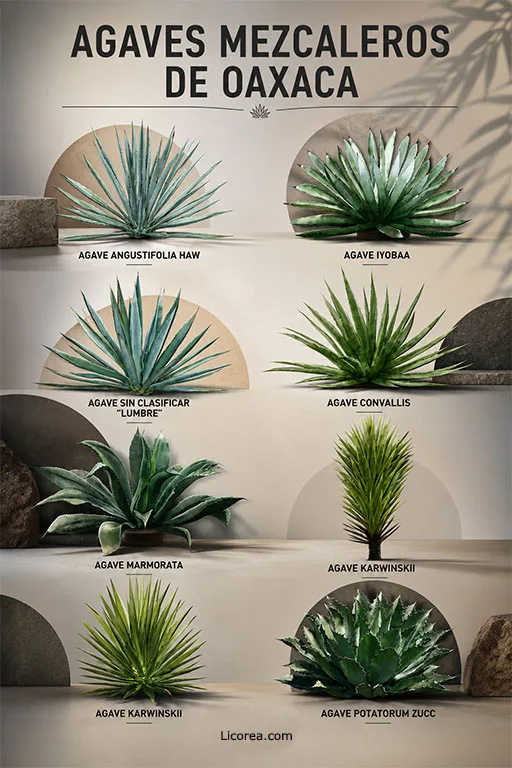
Introduction to the main species and varieties used in mezcal production
Americana
Common names: Arroqueño
This species can take up to 25 years to reach maturity. According to Hernández, it usually produces smooth, sweet mezcals with pleasant citrus notes.
Angustifolia
Common names: Espadín, Espadilla, Pelón Verde, Tepemete
Up to 90% of the mezcal available on the market is made from this species. Agave angustifolia needs only six to eight years to mature and has a high concentration of sugars, making it possible to obtain a larger amount of mezcal than from other varieties. These characteristics make its production more affordable.
If you have ever ordered a cocktail made with mezcal, it was most likely produced with Agave angustifolia, better known as espadín.
Karwinskii
Common names: Baicuishe, Barril, Cuishe, Madre Cuishe, Pacheco, Tobaziche, Verde
This species is usually used to make smaller batches. According to Hernández, its mezcals tend to show earthy, mineral and slightly saline profiles.
The specialist compares its flavour to worm salt, the seasoning made with salt, chilli and maguey worm that is traditionally served alongside mezcal.
Marmorata
Common names: Pichumel, Tepeztate
Agave marmorata is known for its extremely slow growth, as it can take up to 35 years to reach maturity. This long time in the ground often results in intense, spicy flavours, with notes that may recall pepper and cinnamon.
However, its profile can vary considerably depending on origin and producer. One of Vásquez’s favourite pichumeles, made by Maestro del Mezcal in Puebla, shows a floral, sweet character with a long finish.
Potatorum
Common names: Papolome, Tobalá
Sometimes known as the “king of mezcal”, Agave potatorum is a small but highly prized plant. It is especially noted for its characteristic sweetness and for the high prices often reached by mezcals made from it.
Unlike other agave species, which can reproduce through offshoots or genetic clones of the mother plant, Agave potatorum reproduces only from seed. This particular trait makes it harder to cultivate and limits its availability.
Rhodacantha
Common names: Cuixe, Mexicano
Agave rhodacantha is a relatively uncommon species. Hernández describes mezcals made from it as floral and delicate, with a sweet finish reminiscent of cooked agave nectar.
Ensambles
Mezcals made by combining different agave species or varieties are known as ensambles.
As you can see, these varieties need decades to reach the ideal level of maturity before they can become Mezcal. This is the main reason behind their exclusivity and limited availability.
How to drink mezcal
The most respectful way to approach mezcal is to serve it neat, in small measures, and sip it slowly. Low copitas, jícaras or small glasses allow you to appreciate its aromas without rushing.
In Mexico, it is commonly served with orange and worm salt, although this is not essential: a good mezcal can be enjoyed perfectly well on its own.
In cocktails, mezcal has gained ground thanks to its ability to bring depth to classic recipes. It works well in versions of a Margarita, Negroni, Paloma or Old Fashioned, especially when a drier, smokier or more vegetal profile is desired. For mixing, it is usually sensible to use a well-balanced espadín and keep more singular bottles for sipping.
A rapidly expanding category
Mezcal’s international growth has created opportunities for producers and consumers, but it also brings challenges. Demand can put pressure on slow-maturing agave species, alter traditional methods or favour industrial models. For this reason, traceability is increasingly valued: who makes it, with which agave, in which community and under what practices.
Choosing mezcal wisely is not just about looking for an eye-catching label. It means understanding that behind every bottle there is a plant, a landscape, a family and a specific way of doing things. That is where its true appeal lies: not simply in being smoky, but in offering one of the most diverse and culturally rich expressions in the world of spirits.