
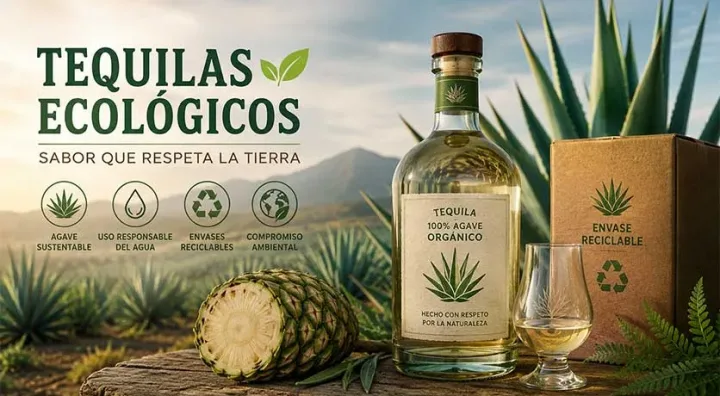
The word “organic” has become one of the most appealing terms on the spirits shelf. In wine, beer and distilled drinks, it suggests respect for the land, careful production and more mindful consumption. With tequila, however, it is worth pausing before drawing quick conclusions. A bottle labelled organic does not automatically mean it is “additive-free,” nor that it tastes better, nor that it comes from an artisanal distillery in the romantic sense of the word.
Organic tequila is, above all, the result of a regulated system that affects agave cultivation, the management of inputs, traceability and the separation of raw materials during production. It is a demanding certification, but its boundaries need to be clearly understood so as not to attribute qualities to it that it does not necessarily guarantee.
It starts in the field, not on the label
To understand organic tequila, one must begin with Weber blue agave, the plant from which tequila is made. Unlike other short-cycle agricultural crops, agave takes several years to reach maturity. This turns every decision about soil management, fertilisation or pest control into a long-term commitment.
In organic production, the land must meet strict requirements regarding the use of synthetic fertilisers, herbicides and pesticides. The general principle is to avoid certain substances and to prove, through records and audits, that the crop has been managed in accordance with the standards of the relevant certification body. It is not enough to claim that the work is done “naturally”: there must be verifiable documentation.
This is one of the key differences between responsible farming practices and organic certification. A producer may take great care of their fields using sustainable methods, reduce chemical treatments or work with compost, but without a formal certification process, they cannot legally present their tequila as organic in markets where that claim is regulated.
Organic and additive-free are not the same thing
One of the most common misunderstandings concerns additives. In tequila, the debate around so-called abocantes—substances permitted under Mexican regulations in certain proportions—is increasingly present among enthusiasts and professionals. These may include tools intended to adjust colour, sweetness, texture or the impression of oak.
But organic certification and the absence of additives answer different questions. The former focuses on how the raw material is grown and handled, as well as on certain aspects of processing and traceability. The latter refers to whether or not the tequila includes authorised elements used to modify its final profile. A tequila may be organic and, depending on the applicable regulations and its production practices, not necessarily be free from all permitted additives. Likewise, a tequila may be made without additives and not be organic.
For consumers, this means it is worth reading carefully and not assuming that one statement replaces the other. “Organic,” “100% agave,” “additive-free,” “reposado” and “añejo” are different kinds of designations and respond to different regulatory criteria.
The distillery matters too, but the requirements begin earlier
Once the agave piñas have been harvested, the process continues at the distillery: cooking, juice extraction, fermentation, distillation and, where applicable, ageing in wood. In production certified as organic, the distillery must maintain controls to prevent mixing with non-certified raw materials, use approved cleaning products or processing aids, and keep records that make it possible to trace the product from field to bottle.
This is especially important in distilleries that produce several brands or different types of tequila, some organic and others conventional. The physical, temporal or documentary separation of batches is not a minor detail: it is part of the system that supports the certification. The word organic does not rest merely on a declaration of intent, but on audits, inspections and procedures repeated each season or operating year.
Does organic tequila taste better?
The most honest answer is: not necessarily. There can be excellent organic tequilas and others that are merely correct, just as with non-certified tequilas. The final flavour depends on many factors: agave maturity, cooking method, type of mill, yeasts, fermentation, distillation cuts, water quality, barrel use and the decisions of the master tequilero.
It is reasonable to think that careful cultivation, with living soils and attentive plant management, may favour high-quality raw material. It is also true that many brands committed to organic production often pair that philosophy with a less interventionist approach to making tequila. But certification alone does not assess aromas or balance on the palate. It does not certify notes of cooked agave, citrus, pepper, fresh herbs or vanilla. It certifies compliance with standards.
That is why, from a tasting perspective, organic should be seen as an indicator of process, not an organoleptic guarantee. The final test is still in the glass.
A costly commitment that is hard to improvise
Organic tequila is not produced at the flick of a switch. The long agave cycle requires planning years in advance. If a plot needs a transition period to meet organic criteria, the producer must absorb that time without being able to immediately market the crop as certified. In addition, any accidental contamination or use of unauthorised substances can compromise the process.
This is compounded by higher costs for labour, weed control, pest management, audits, certifications, team training and traceability systems. In a crop such as agave, where pressure on the availability and price of raw material can be significant, choosing organic means tying up resources for a long time.
Some distilleries complete this approach through composting agave fibres, making use of by-products or running soil improvement programmes. These practices are not always mandatory for certification, but they fit with a more circular vision of tequila production and help reduce the impact of the process.
What consumers should look for
For anyone looking to buy organic tequila with confidence, it is best not to focus solely on the seal. It helps to check whether the brand explains the origin of its agave, details its production method, states whether it works without additives, identifies the distillery and communicates transparently about its certifications. The more verifiable information, the better.
When serving, an organic blanco tequila can be a good choice for appreciating the character of agave directly, especially if enjoyed neat, slightly chilled or in cocktails where it is not hidden by very dominant ingredients. A reposado or añejo, meanwhile, will show how that vegetal profile interacts with wood, provided the ageing does not overly mask the raw material.
Organic tequila represents a demanding way of working the land and documenting every step of the process. It is not a magic formula, nor an absolute guarantee of sensory purity. But it can be a valuable clue for those who value traceability, responsible agriculture and a more conscious relationship between the agave, the producer and the bottle.