
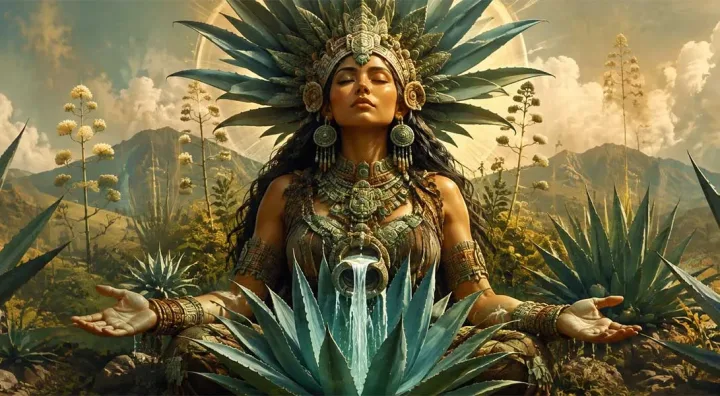
The international rise of tequila and mezcal has placed agave at the heart of the conversation around premium spirits, cocktail culture and Mexico’s liquid heritage. Yet reducing this plant to the raw ingredient behind two fashionable drinks would be to skim the surface. Long before it appeared on craft cocktail bars, collectible labels or specialist tasting flights, agave already held an essential place in the everyday, economic and spiritual life of various Mesoamerican cultures.
Its importance was born not of luxury, but of usefulness. Agave served as an agricultural resource, an energy reserve, a source of fibre, food, material for utensils and the basis for fermented drinks. In regions shaped by dry climates, its resilience and ability to thrive where other crops struggled made it a plant of immense value. Its symbolic dimension is therefore hardly surprising: societies tend to sanctify what they depend on in order to live.
A plant of survival before a plant of distillation
Agave belongs to a group of plants adapted to demanding environments. Its slow growth, the concentration of sugars in its heart, or piña, and its ability to withstand periods of drought help explain why it became so important in areas where resources could be unpredictable. It was not simply a plant to be used at a particular moment, but a kind of long-term natural reserve.
Its leaves yielded fibres used for ropes, textiles and everyday household items. Its rigid tips served as sharp tools. Some parts were eaten as food, while its sap made it possible to produce fermented drinks. This versatility made agave more than a crop: it was a plant-based technology in the service of daily life.
This practical relationship helps explain why agave eventually became woven into religious and mythological narratives. It was not merely an abundant plant, but an element capable of providing shelter, drink, food, tools and social cohesion. In many cultures, the material and the sacred were rarely sharply separated.
Mayahuel and the maternal dimension of agave
In Mexica mythology, one of the figures most closely associated with agave is Mayahuel, a deity linked to fertility, nourishment and pulque, the fermented drink obtained from the aguamiel of certain maguey species. Her image is often connected with the plant itself, to the point of appearing as a presence that springs from it or merges with its nature.
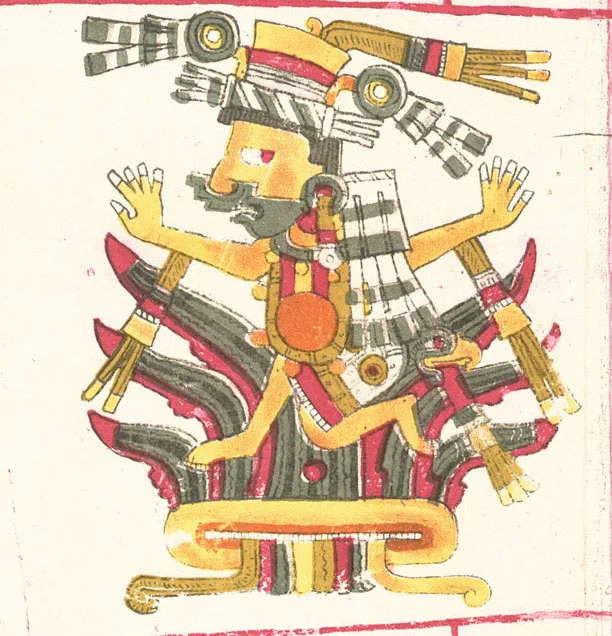
The symbolic reading is clear: agave feeds, protects, clothes and provides drink. Its link with motherhood and fertility should therefore not be understood solely through intoxication, but through the idea of sustenance. Mayahuel represents the plant’s ability to support life and to connect the community with the cycles of the earth.
In this sense, agave shares traits with other products that different civilisations have ritualised. Wheat, the vine, cacao and coffee were not important only for their flavour or their effects, but for their role in food, trade, sociability and ceremony. When a food or drink helps organise collective life, it ends up accumulating meanings that go far beyond consumption.
Pulque: the agave drink that came before tequila
To understand the history of agave, one must look beyond distillation. Tequila and mezcal belong to a later stage, linked to the development of distillation techniques and to the consolidation of categories recognised today. Before them there was a culture of fermented drinks, and pulque occupied a prominent place.
Pulque is made from aguamiel, the sap extracted from the maguey plant. Its fermentation produces a drink with an appearance, texture and sensory profile very different from those of a distilled spirit. Historically, it was tied to social, ceremonial and religious settings. Its consumption was not always seen as an everyday act without consequences, but as an experience governed by rules, hierarchies and meanings.
This distinction matters for today’s enthusiast. Agave culture did not begin with tequila or bottled mezcal. The relationship between Mesoamerican communities and agave drinks is older and broader. It includes fermentation, ritual, agriculture, local identity and ways of understanding the transformation brought about by alcohol.
The “four hundred rabbits” and the many faces of intoxication
Among the most striking elements in the mythology associated with pulque are the Centzon Tōtōchtin, commonly known as the “four hundred rabbits”. In Nahua tradition, this multitude of spirits linked to drink and intoxication should not be read as a literal number, but as a way of expressing abundance, excess and variety.
The choice of the rabbit as a symbol is especially evocative. It is an animal associated with fertility, proliferation and unpredictable movement. Applied to alcohol, it helps explain something every culture has observed: intoxication does not affect everyone in the same way, nor does it always lead to the same behaviour.
The same amount consumed may result in euphoria, melancholy, aggression, tenderness, introspection or disinhibition. Mythology offered a language for describing that transformation of personality before scientific explanations of alcohol, the nervous system or behaviour existed. Rather than seeing intoxication as a simple chemical effect, it was understood as a plural, shifting force that was difficult to master.
Fermentation, mystery and drinks culture
Seen from the present day, fermentation is a familiar process: yeasts, sugars, temperature and time. For centuries, however, it must have seemed almost invisible and bewildering. A sweet liquid would turn into a drink capable of altering perception, changing mood and encouraging experiences of communion or loss of control.
It is no coincidence that many alcoholic drinks have been surrounded by religious narratives, prohibitions, rituals and celebrations. Wine in the Mediterranean, ancient beers, cacao drinks in Mesoamerica and fermented beverages from many regions all show that alcohol has been not only liquid nourishment or a commercial product, but also a cultural tool for marking rites of passage, sealing alliances, honouring the gods or bringing the community together.
Agave fits fully into this universal pattern, yet with an identity of its own. Its botanical resilience, the way every part of it could be used, and its presence in arid landscapes gave it an especially powerful symbolic charge. Before speaking of ageing, terroir, ovens, tahonas or smoky profiles, it is worth remembering that agave’s cultural roots lie in survival and in its bond with the land.
From ancient symbol to contemporary spirit
Today, consumers approach agave through categories such as tequila, mezcal, raicilla, bacanora and sotol, although the latter comes from a different desert plant. Each of these drinks has its own rules, territories, techniques and styles. In tequila, blue agave takes centre stage; in mezcal, the diversity of species and traditional methods offers remarkable sensory richness.
Understanding agave’s sacred and practical past does not mean idealising every modern bottle, but it does help us drink with greater context. Behind these spirits there is a slow-maturing plant, a historic relationship with specific communities and an imaginary world that long predates the global industry.
Perhaps that is why agave continues to fascinate. It is not merely an ingredient, nor a cocktail trend. It is a plant that first sustained ways of life, later inspired myths and, ultimately, gave rise to some of the world’s most distinctive spirits. Long before it was distilled, agave was already culture.