
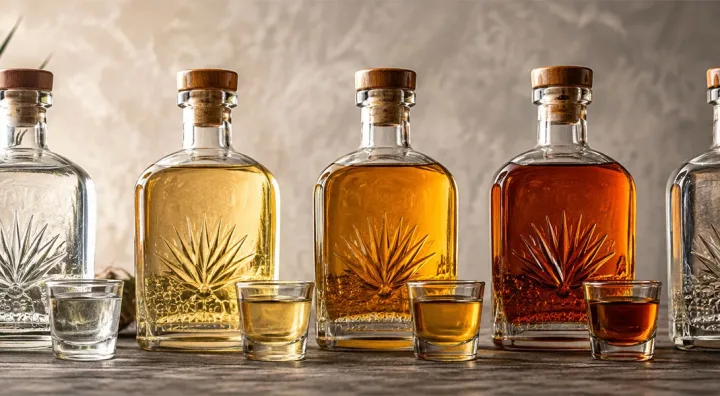
Tequila is enjoying a period of remarkable interest outside Mexico. It is no longer seen only as the base for a Margarita or as a spirit to be knocked back in one shot, but as a complex category, with nuances shaped by agave, terroir, cooking, fermentation and, in many cases, ageing. Understanding its main styles helps you choose a bottle more wisely and enjoy it with greater appreciation.
All tequilas begin with Weber blue agave, a plant grown mainly in Jalisco and in certain authorised areas of other Mexican states. The designation of origin protects its production and sets rules for raw materials, processes and categories. From the same plant can come very different profiles: from clear, fresh, herbaceous tequilas to darker, rested expressions with hints of vanilla, spices and dried fruit.
The starting point: blue agave and designation of origin
To talk about types of tequila, it is worth beginning with where it comes from. Blue agave needs several years to mature before it is harvested by the jimadores, who remove the leaves to keep the heart of the plant, known as the piña. These piñas are cooked to convert their starches into fermentable sugars, then crushed to extract the juice and, after fermentation, the resulting liquid is distilled.
Most tequilas are distilled at least twice. After that, the spirit can be bottled with virtually no ageing or spend time in wooden vessels to gain colour, texture and aroma. This is where the main categories appear: blanco, reposado, añejo and extra añejo, along with styles such as joven or cristalino.
It is also important to distinguish between tequila made with 100% blue agave and mixto tequila. The latter may include other permitted sugars, although consumers looking for a truer expression of agave usually look for the words “100% agave” on the label.
Blanco tequila: the most direct expression of agave
Blanco tequila, also known as plata or silver, is the cleanest-looking style and the one that best shows the immediate character of cooked agave. It may spend a short resting period before bottling, but in general it has no pronounced influence from wood.
Its profile often moves between vegetal, citrus, herbaceous and spicy notes, with a fresh sensation that makes it a highly versatile choice for cocktails. It is the usual tequila in serves such as the Margarita or the Paloma, precisely because its brightness works so well with lime, grapefruit, salt and other sharp ingredients.
That does not mean blanco is reserved only for mixing. The best blanco tequilas can be sipped neat, in a suitable glass and without rushing, to appreciate the cooking point of the agave, its minerality, white pepper or the floral nuances offered by some producers.
Reposado: balance between freshness and oak
Reposado tequila occupies a very interesting middle ground. After distillation, it rests for a period of between two months and one year in wood, usually barrels that have held American whiskey, which bring a gentle colour and an additional aromatic layer. The influence of the barrel should not erase the agave, but round it out.
On the nose and palate it can combine notes of cooked agave, ripe citrus and pepper with touches of vanilla, light caramel, honey, dried fruit or sweet spices. Thanks to that balance, reposado works well both neat and in more structured cocktails. It can add depth to a more gastronomic Margarita or stand in for dark spirits in classic-inspired drinks.
For many enthusiasts, reposado is the ideal gateway into sipping tequila: it retains some of the energy of a blanco, while offering a softer texture and an aromatic complexity closer to other aged spirits.
Añejo and extra añejo: tequila in conversation with the barrel
Añejo tequila spends longer in wood than reposado, from one to three years. The cask, limited to a maximum of 60 litres, takes on a more prominent role, bringing deeper profiles, amber hues and a more enveloping mouthfeel. In this style, notes of vanilla, cocoa, caramel, baking spices, dried fruit and polished oak are common.
Because of its character, añejo is usually enjoyed neat, at a moderate serving temperature and in a glass that helps concentrate its aromas. It can also be used in cocktails when you want an alternative to whisky or aged rum, although it is best not to hide its identity beneath ingredients that are too dominant.
Extra añejo takes that logic one step further. Its extended ageing of up to 10 years intensifies the imprint of the wood and places some tequilas in a sensory territory close to that of old rums, brandies or whiskies. These are bottles designed mainly for slow tasting, where the dialogue between agave and cask is at the heart of the experience.
Joven, gold and cristalino: categories worth reading carefully
Joven tequila, also known in some markets as gold or oro, can refer to different realities. In more carefully made versions, it is a blend of blanco tequila with a portion of aged tequila. The result aims to add freshness and a certain roundness. However, in more basic segments, some references labelled as gold may include colourings or other elements intended to soften the perception of the spirit. That is why the label matters.
Cristalino tequila, meanwhile, is a more recent phenomenon. It starts with an aged tequila that is then passed through a charcoal filtration process to remove colour and some of the compounds associated with wood. Visually it resembles a blanco, but it aims to retain traits of a matured tequila: silky texture, sweet notes and a more polished profile.
Not all enthusiasts see it in the same way. For some, cristalino offers an accessible route into aged tequila; for others, filtration can strip away part of its identity. In any case, its presence on the market confirms the category’s ability to innovate and attract new consumers.
How to choose a tequila according to its use
Rather than thinking of one category as “better” than another, it is better to choose tequila according to the drinking occasion:
- For fresh cocktails: blanco, especially in a Margarita, Paloma or citrus-led highballs.
- For fuller-bodied cocktails: reposado, ideal when you want a touch of wood without losing the agave character.
- For sipping neat: reposado, añejo or extra añejo, depending on whether you prefer fresher profiles or styles more strongly shaped by the cask.
- For exploring modern styles: cristalino, always checking the label information and the type of base tequila.
Tequila is a broad category, closely tied to Mexico and to an extraordinarily expressive plant. Understanding its types does more than help you buy better: it also reveals how the same raw material can become very different spirits, from the vegetal purity of a blanco to the spiced complexity of an extra añejo.